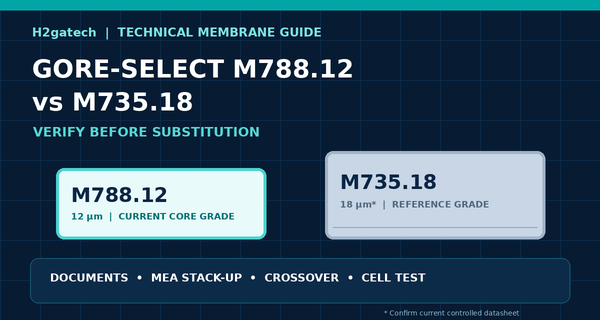

GORE M788.12 vs M735.18: PEM Membrane Comparison
GORE-SELECT M788.12 and M735.18 are not interchangeable simply because both are reinforced proton-exchange membranes for PEM fuel cells. Gore’s current public core portfolio lists M788.12 as a 12 µm membrane. M735.18 appears in Gore’s product-generation and performance history, while a current Gore regional product page directs buyers to contact a Gore representative for M735.18 information. This means a responsible comparison must separate verified current specifications from legacy or project-specific data.
The practical conclusion is straightforward: treat a change from M735.18 to M788.12 as a material and MEA requalification, not as a thickness-only substitution. Confirm the controlled data sheet, supply status, coating process, seal stack-up, crossover limits, operating conditions, and cell test protocol before approving the replacement.
For H2gatech’s available membrane and assembly options, review the membrane electrode assembly product range.
The Short Answer
Question | M788.12 | M735.18 | Buyer action |
Current public position | Included in Gore’s current core product table. | Referenced in Gore technical history; current regional page says to contact Gore for information. | Request current controlled documents and commercial status. |
Thickness information | Nominal 12 µm in Gore’s current data sheet. | Associated with the 18 µm product designation and Gore’s earlier 15–20 µm generation. | Do not use the grade name as the only incoming criterion. |
Detailed public values | Current values are published for thickness, proton resistance, crossover, strength, swelling and other properties. | A directly comparable current public specification table was not located. | Compare values only when test conditions and methods match. |
Replacement decision | Candidate for a qualified design or requalification program. | Existing qualification may include historical cell and process data. | Test the complete MEA and cell, not the membrane name alone. |
What Gore Currently Publishes for M788.12
Gore’s current fuel-cell membrane page positions M788.12 for automotive, backup-power, range-extender, forklift, and portable applications. It describes the grade in terms of high mechanical durability, low gas permeance, and cost effectiveness. The current Gore portfolio data sheet lists the following method-specific values.
Published field | M788.12 value | Why buyers should read the condition |
Nominal thickness | 12 µm | Thickness affects MEA handling and cell stack-up, but nominal thickness alone is not a complete acceptance specification. |
Proton resistance | <120 mΩ·cm² at 80 °C and 30% RH | Resistance results depend on the test method, conditioning, temperature, and humidity. |
Hydrogen crossover | 30 mA/cm²/MPa at 80 °C and 50% RH | The unit is normalized by pressure; it is not the same as a finished-cell leak rate. |
Tensile strength | 71 MPa MD; 76 MPa TD | Machine and transverse directions matter for converting, coating, framing, and handling. |
Area swelling | <5% under Gore’s stated conditioning method | Swelling affects coated-area registration and the frame or gasket design. |
These values should be copied from the manufacturer’s current controlled data sheet when they become purchasing requirements. Do not compare a Gore data-sheet value with a supplier or laboratory result obtained by another method and assume the numbers are equivalent.
What Can Be Said Carefully About M735.18
M735.18 appears in Gore’s membrane-development charts as an earlier-generation reinforced membrane in the 15–20 µm thickness group. Gore’s current regional product page does not include it in the core specification table and instead advises customers to contact a local Gore representative for M735.18 information. That is not the same as an official discontinuation notice.
For an existing M735.18 design, the buyer should retain the qualified data sheet revision, certificate fields, storage history, catalyst-coating process, frame and gasket drawing, assembly compression, and baseline test results. Those records are more useful for a replacement program than an online summary or an old nominal thickness value.
Why 12 µm vs 18 µm Is Not the Whole Decision
Electrical Resistance and Water Transport
A thinner proton-conducting path can reduce membrane resistance, especially when the membrane remains appropriately hydrated. However, cell resistance also includes catalyst-layer ionomer, interfaces, GDL contact, bipolar-plate contact, compression, and operating humidity. M788.12 should therefore be evaluated in the complete MEA rather than credited with a guaranteed voltage gain based only on thickness.
Gas Crossover and Pressure Conditions
Membrane thickness, reinforcement, defects, hydration, temperature, and differential pressure all affect gas crossover. Gore’s M788.12 data include a hydrogen-crossover value under a defined laboratory condition. An existing M735.18 cell may use a different test method or acceptance limit. Compare like-for-like measurements and include the project’s actual pressure window and safety limit.
Handling, Coating, and Dimensional Control
Changing membrane grade can alter how the film releases from its backer, lies flat, responds to moisture, registers to the catalyst area, and behaves during framing or lamination. Reinforcement improves dimensional and mechanical behavior, but it does not eliminate the need for controlled handling. The converter should confirm orientation instructions, backer removal, storage, conditioning, and accepted visual criteria from the current documentation.
Seal Stack-Up and Compression
A nominal 6 µm membrane-thickness difference does not automatically require a 6 µm gasket change. The final stack-up includes catalyst layers, GDLs, frames, adhesives, gaskets, tolerances, and compression. Review the complete cross-section drawing and compressed target instead of adjusting one component in isolation.
For another example of why membrane thickness must be considered with the complete cell, read Nafion NR211 vs NR212: How to Choose a PEM Fuel Cell Membrane.
A Practical Replacement Validation Plan
Validation stage | What to compare | Recommended evidence |
1 Documents | Grade name, data-sheet revision, certificate fields, storage, shelf-life guidance, backer and orientation instructions | Approved material specification and supplier confirmation |
2 Incoming material | Thickness by agreed method, appearance, dimensions, handling condition and lot identity | Incoming inspection record and lot traceability |
3 CCM process | Coating registration, catalyst loading, adhesion, drying response, flatness and visual defects | Process record and agreed in-process inspection |
4 MEA integration | Frame overlap, adhesive compatibility, GDL choice, gasket stack-up, alignment and compression | Cross-section drawing and assembled-thickness check |
5 Cell performance | Conditioning, polarization curve, high-frequency resistance, crossover or leak behavior and water management | Same hardware and protocol for baseline and candidate |
6 Durability | Duty-cycle response, wet-dry or start-stop exposure, voltage degradation and post-test inspection | Project-relevant durability or accelerated test plan |
H2gatech engineering observation: a membrane replacement request should include the existing MEA drawing, membrane grade and revision, active area, catalyst-coated border, frame and gasket thickness, GDL specification, cell pressure, humidity, duty cycle, and baseline acceptance test. A product number alone does not show whether the original qualification covered only the membrane or the entire MEA and stack interface.
Use How to Specify a Custom Fuel Cell MEA to organize the drawing, materials, operating window, and acceptance fields for quotation.
Buyer Checklist for an M735.18 Replacement Project
· Obtain the current M788.12 controlled data sheet and written supply confirmation.
· Retain the exact M735.18 data-sheet revision and certificate from the qualified design.
· Define which published properties are mandatory acceptance criteria and which are reference values.
· Confirm membrane dimensions, roll or sheet format, backer, orientation, packaging, storage, and lot identification.
· Review coating, framing, gasket, GDL, adhesive, and compressed stack-up requirements.
· Use the same active area, cell hardware, compression, conditioning, gases, temperature, humidity, pressure, and test sequence for comparison.
· Agree on crossover, leak, electrical, performance, durability, and documentation acceptance limits before samples are made.
· Approve substitution only after material, MEA, and cell evidence supports the intended operating window.
If GDLs are included with the coated membrane, confirm whether the required supply scope is a 3-layer or 5-layer MEA.
Example RFQ Wording
“Please evaluate GORE-SELECT M788.12 as a replacement candidate for our currently qualified M735.18-based PEM fuel cell MEA. Use the attached drawing and baseline bill of materials. Confirm the current membrane data-sheet revision, supply format, backer and handling instructions, certificate fields, and proposed incoming checks. Quote prototype CCMs and framed 5-layer MEAs for side-by-side evaluation under our attached cell and durability protocol. No substitution is approved until written sample acceptance.”
Frequently Asked Questions
Can M788.12 replace M735.18 without changing the MEA?
Not automatically. The membrane change can affect coating, dimensional registration, handling, seal stack-up, crossover, resistance, and cell durability. Use a documented requalification plan.
Is M788.12 always the higher-power choice?
No. A thinner reinforced membrane may support low resistance, but finished-cell performance depends on the catalyst layers, interfaces, GDLs, compression, humidity, temperature, pressure, and flow fields.
Is M735.18 discontinued?
Do not state that without current manufacturer or authorized-channel confirmation. Gore’s current public core table does not provide a directly comparable M735.18 specification and a regional Gore page directs customers to contact a representative.
Should the gasket be reduced by exactly 6 µm?
No. Review the full compressed cell stack-up, including catalyst layers, frames, adhesives, GDLs, gaskets, component tolerances, and the hardware compression target.
Can these membranes be selected for PEM water electrolysis?
The cited Gore product information is for fuel-cell membranes. Do not transfer a fuel-cell selection directly to an electrolyzer; confirm application approval, pressure, gas crossover, catalyst compatibility, and durability with the membrane manufacturer and validate the electrolyzer cell.
Discuss a Custom PEM Fuel Cell MEA
H2gatech supports customized CCMs, framed components, and 3-layer and 5-layer PEM fuel cell MEAs. Send the existing membrane specification, drawing, catalyst layers, GDLs, sealing stack-up, operating conditions, sample quantity, and acceptance protocol. Contact H2gatech to review a controlled comparison and prototype plan.
Technical References
• W. L. Gore - PEM Fuel Cell Membranes for Hydrogen Power Systems - current product positioning for the GORE-SELECT membrane portfolio and M788.12.
• W. L. Gore - Fuel Cell Portfolio Data Sheet - published M788.12 physical and performance fields and Gore membrane-generation context.
• U.S. Department of Energy - Technical Targets for PEM Fuel Cell Components - technical context for membrane resistance, crossover, and mechanical-durability evaluation.