
Nafion NR211 vs NR212 How to Choose a PEM Fuel Cell Membrane
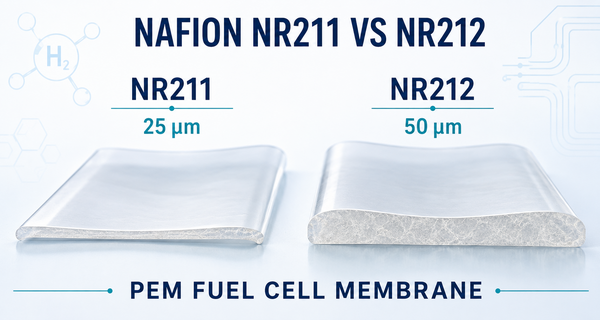
Nafion NR211 and Nafion NR212—often searched as Nafion N211 vs N212—are both chemically stabilized, solution-cast proton exchange membranes commonly used in fuel cells. The most important difference is thickness: NR211 is approximately 25 micrometers thick, while NR212 is approximately 50 micrometers thick. That difference affects ionic resistance, hydrogen crossover, mechanical handling, sealing, and durability. Neither membrane is automatically better for every project. The right choice depends on the cell design, operating conditions, performance target, and manufacturing process.
The Main Difference Between Nafion NR211 and NR212
Parameter | Nafion NR211 | Nafion NR212 | Practical meaning |
Nominal thickness | 25 µm | 50 µm | NR211 is about half the thickness of NR212. |
Membrane format | Solution-cast PFSA | Solution-cast PFSA | Both are chemically stabilized Nafion membranes. |
Ionic path | Shorter | Longer | A thinner membrane can reduce proton transport resistance. |
Gas crossover control | More demanding | Generally more forgiving | A thicker membrane can provide a larger barrier between reactant gases. |
Handling | More delicate | Easier to handle | NR212 is usually less sensitive during manual cutting and assembly. |
Typical decision priority | Lower resistance and compact MEA | Handling, robustness, and crossover margin | Final selection still requires cell testing. |
Technical reference: Chemours lists Nafion NR211 at 25 µm and NR212 at 50 µm. Always verify the current manufacturer datasheet and incoming material specification before production.
How Thickness Affects Fuel Cell Performance
1. Proton Transport Resistance
Protons must travel through the membrane from the anode to the cathode. A thinner membrane creates a shorter transport path and can reduce ohmic resistance. In a well-designed cell, this may support higher voltage at a given current density. However, the membrane is only one part of the total resistance. Catalyst-layer ionomer, contact pressure, GDL structure, hydration, and interface quality also matter.
2. Hydrogen Crossover
Reducing thickness can increase sensitivity to gas crossover. Excessive crossover lowers fuel utilization and may affect durability or safety. The real crossover level depends on membrane condition, temperature, differential pressure, humidity, pinholes, and edge sealing. If the project uses elevated pressure or a demanding duty cycle, crossover testing should be part of material validation.
3. Mechanical Handling and Assembly
NR211 is thin and must be handled carefully during catalyst coating, die cutting, hot pressing, framing, and stack assembly. Wrinkles, local stretching, contamination, or uneven compression can create defects. NR212 provides more handling margin, which can be useful for laboratory assembly, lower-volume production, or designs with a complex seal frame.
4. Water Management
PFSA membranes require appropriate hydration to maintain proton conductivity. Membrane thickness affects water transport, but it should not be considered separately from inlet humidity, operating temperature, current density, gas stoichiometry, and cathode water removal. A thin membrane cannot compensate for an unsuitable operating strategy, and a thicker membrane cannot correct poor sealing or uneven compression.
When Should You Choose Nafion NR211?
NR211 may be a good candidate when low membrane resistance is a priority and the manufacturing process can reliably handle a 25 µm film. Typical reasons to evaluate NR211 include:
· The project targets a thin, compact MEA and high current-density performance.
· Coating, framing, and assembly processes are already controlled for thin membranes.
· Differential pressure and crossover are managed and verified by testing.
· The cell hardware provides uniform sealing and compression.
When Should You Choose Nafion NR212?
NR212 is often evaluated when handling robustness and crossover margin are more important than achieving the lowest possible membrane resistance. It may be suitable when:
· The MEA will be manually assembled or frequently changed during laboratory testing.
· The project needs a more forgiving membrane for cutting, framing, and sealing.
· Durability and gas separation margin are higher priorities than minimum thickness.
· The design is at an early stage and requires a stable baseline for comparison.
H2Gatech | English Website Publishing Copy
The Membrane Is Only One Part of the MEA
A membrane choice should be made together with the catalyst layers, gas diffusion layers, seal frame, active area, and operating conditions. Two MEAs using the same NR211 or NR212 membrane can perform differently because of catalyst loading, ionomer ratio, coating uniformity, hot-pressing conditions, GDL compression, and cell hardware.
Before requesting a custom MEA, specify:
· Fuel cell type and intended application
· Active area and external dimensions
· Operating temperature, humidity, pressure, and gas type
· Anode and cathode catalyst type and loading in mgPt/cm²
· MEA architecture (three-layer CCM or five-layer MEA) and GDL grade, thickness, PTFE treatment, and MPL requirement
· Seal-frame material, thickness, holes, and orientation
Frequently Asked Questions
Are Nafion NR211 and NR212 made from the same type of material?
Both are chemically stabilized, solution-cast Nafion PFSA membranes. Their most visible specification difference is nominal thickness: 25 µm for NR211 and 50 µm for NR212.
Does Nafion NR211 guarantee higher power?
No. Its lower thickness can reduce membrane resistance, but actual cell performance depends on the entire MEA, operating conditions, compression, flow field, and water management.
Can NR211 or NR212 be used in a PEM electrolyzer?
Membrane selection for water electrolysis must consider differential pressure, gas crossover, catalyst compatibility, and durability. Do not select a membrane only because it performs well in a fuel cell; validate the material for the electrolyzer's actual operating conditions.
Custom PEM Fuel Cell MEA Support
H2Gatech manufactures customized membrane electrode assemblies and catalyst-coated membranes for PEM fuel cell development and production. We can discuss membrane type, active area, catalyst loading, GDL selection, seal frame, and inspection requirements based on your drawing and operating conditions.
View our membrane electrode assembly solutions or contact H2Gatech to review your MEA specification.