
What Is a PEM Fuel Cell and How Does It Work?
A Simple Guide to PEM Fuel Cell Technology
As the demand for clean and efficient energy continues to grow, hydrogen fuel cell technology is becoming an important solution for transportation, backup power, portable power, and distributed energy applications. Among different types of fuel cells, the Proton Exchange Membrane Fuel Cell, also known as a PEM fuel cell, is widely used because of its high efficiency, compact design, fast start-up, and clean operation.
This article explains what a PEM fuel cell is, how it works, its main components, advantages, and common applications.
What Is a PEM Fuel Cell?
A PEM fuel cell is an electrochemical device that converts the chemical energy of hydrogen directly into electricity.
Unlike traditional engines that generate power by burning fuel, PEM fuel cells produce electricity through an electrochemical reaction between hydrogen and oxygen. During operation, the main by-products are only water and heat, which makes PEM fuel cells a clean and efficient power generation technology.
Because of their high power density, lightweight structure, and quick response, PEM fuel cells are suitable for many clean energy applications, including hydrogen vehicles, UAVs, backup power systems, portable power supplies, and distributed power generation.
How Does a PEM Fuel Cell Work?
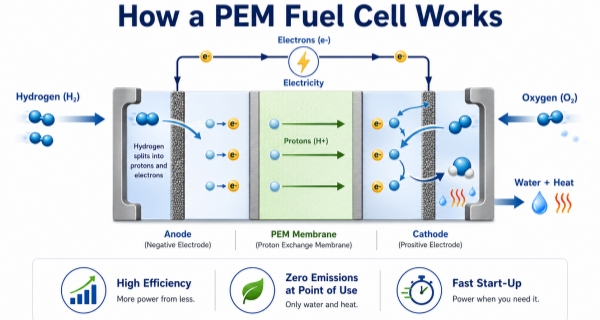
The working principle of a PEM fuel cell is based on the reaction between hydrogen and oxygen inside the fuel cell stack.
1. Hydrogen Enters the Anode
Hydrogen gas is supplied to the anode side of the fuel cell. With the help of a platinum-based catalyst, hydrogen molecules are split into protons and electrons.
2. Protons Pass Through the Membrane
The proton exchange membrane allows only protons to pass through to the cathode side. Electrons cannot pass through the membrane.
This function allows the membrane to separate the gases while enabling ion transfer inside the cell.
3. Electrons Generate Electricity
Since electrons cannot pass through the membrane, they travel through an external circuit. This movement of electrons creates direct current electricity, which can be used to power electrical equipment or charge batteries.
4. Water and Heat Are Produced
At the cathode, oxygen from the air combines with protons and electrons to produce water and heat. The whole process generates electricity without combustion and without harmful exhaust emissions at the point of use.
Main Components of a PEM Fuel Cell
A PEM fuel cell system is made up of several key components.
Membrane Electrode Assembly
The Membrane Electrode Assembly, or MEA, is the core part of a PEM fuel cell. It usually includes a proton exchange membrane, catalyst layers, and gas diffusion layers. The MEA directly affects the power output, efficiency, and durability of the fuel cell.
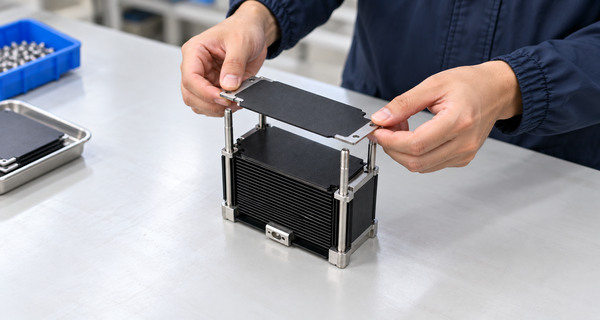
Fuel Cell Stack
A single fuel cell produces only a small voltage. To achieve practical power output, many cells are connected in series to form a fuel cell stack. Fuel cell stacks can be designed in different power ranges according to application requirements.
Bipolar Plates
Bipolar plates distribute hydrogen and air, conduct electricity, support the cell structure, and help manage heat and water inside the stack. Their design has an important influence on stack performance and reliability.
Balance of Plant
A complete fuel cell system also includes supporting subsystems, such as hydrogen supply, air supply, cooling, humidification, control, and power management systems. These parts work together to ensure stable and safe operation.
Advantages of PEM Fuel Cells
PEM fuel cells offer several important advantages:
Clean operation: The main by-products are water and heat.
High efficiency: Hydrogen is converted directly into electricity.
Fast start-up: PEM fuel cells can respond quickly to power demand.
Compact design: High power density makes them suitable for space-limited applications.
Low noise: They operate more quietly than combustion engines.
Low maintenance: Fewer moving parts help reduce maintenance requirements.
These advantages make PEM fuel cells an attractive choice for clean power applications.
Typical Applications of PEM Fuel Cells
PEM fuel cells are used in many fields, including:
Hydrogen fuel cell vehicles
Buses, trucks, and logistics vehicles
Forklifts and material handling equipment
UAVs and portable power systems
Emergency backup power
Telecommunications power supply
Data center backup power
Distributed power generation
Marine power systems
Educational and laboratory demonstration systems
As hydrogen infrastructure continues to develop, PEM fuel cells are expected to play a larger role in clean transportation, industrial power, and distributed energy systems.
Our PEM Fuel Cell Solutions
We provide PEM fuel cell products and customized hydrogen power solutions for research, education, industrial, and commercial applications.
Our capabilities include:
PEM fuel cell stacks
Customized fuel cell systems
Membrane Electrode Assembly solutions
Catalyst Coated Membranes
Gas diffusion layers and related fuel cell materials
Small and medium power hydrogen fuel cell systems
Backup power and portable power solutions
OEM and ODM support
Technical consulting and engineering support
Based on each customer’s application, power requirement, and system design, we can provide suitable hydrogen fuel cell solutions from key components to complete system integration.
Contact Us
PEM fuel cell technology is helping drive the future of clean energy.
Whether you need standard PEM fuel cell products or customized hydrogen power solutions, our team can support your project with reliable products, professional engineering experience, and flexible manufacturing capabilities.
Contact us today to learn more about our PEM fuel cell stacks, MEA solutions, and customized hydrogen fuel cell systems.