
First-Article Approval for Custom MEA and CCM Production
Why First-Article Approval Matters in Custom MEA and CCM Production
A custom membrane electrode assembly can match a drawing and still be unsuitable for production if the material revision, catalyst-loading basis, coated area, frame construction, GDL orientation, packaging, or test conditions are unclear. First-article approval creates a controlled checkpoint between engineering intent and repeated manufacture. It confirms what has actually been built, what has been inspected, what remains to be validated, and which version is authorized for the next batch.
For MEA and CCM projects, this checkpoint is especially useful because a finished part combines thin functional layers whose performance depends on both material selection and processing. First-article approval should not be treated as a ceremonial signature or as proof of long-term durability. It is a documented decision that the initial output is sufficiently defined and reviewed to proceed under agreed conditions.
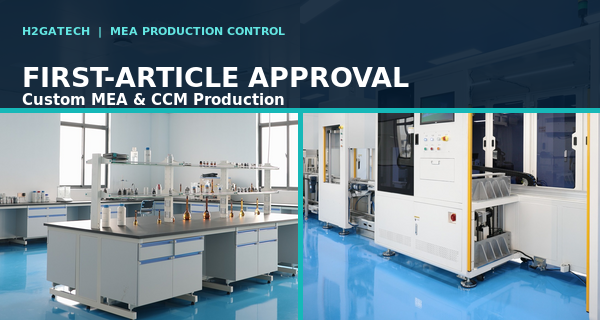
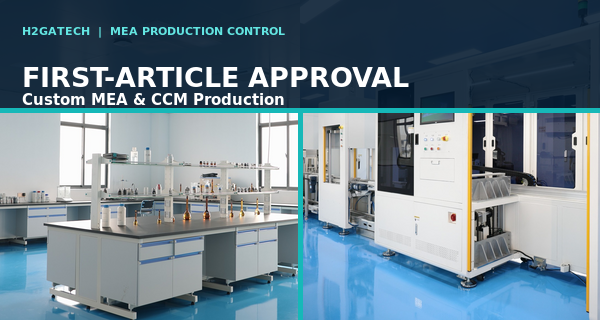
Authentic H2gatech laboratory and production-equipment photographs used as the article feature image.
The Short Answer
First-article approval matters because it converts an RFQ, drawing, bill of materials, and process plan into a reviewed physical sample and a controlled reference. It helps the buyer and manufacturer answer five practical questions: Was the correct revision used? Were the included layers and materials identified? Does the part match agreed dimensions and visual criteria? Were process and inspection records completed? Is the evidence sufficient to release the next quantity?
What First-Article Approval Means for an MEA Project
In this article, “first article” means the first representative unit or small set made after the production specification has been defined. Depending on the project, it may follow a development sample, a tooling change, a material revision, or a transfer from laboratory work to a controlled production route. It is not necessarily a formal aerospace First Article Inspection Report, and it should not be described that way unless the contract requires that standard.
The approval package should match the risk and maturity of the program. A research CCM may need a concise record of membrane, catalyst, coated area, dimensions, appearance, and test conditions. A framed 5-layer or 7-layer MEA may require more detailed control of GDL grade and orientation, frame overlap, adhesive, holes, thickness stack-up, packaging, and customer drawing revision.
First-Article Review at a Glance
Review area | Typical evidence | Why it matters |
Document revision | Drawing, specification, purchase order, approved deviations, and bill of materials | Prevents an obsolete or incomplete version from becoming the production reference. |
Material identity | Membrane, anode and cathode catalyst, ionomer, GDL, frame, adhesive, and packaging | Confirms that trade names, grades, sides, and reporting bases are unambiguous. |
Dimensions | Outer profile, active area, coated area, holes, datums, overlap, orientation, and thickness basis | Connects the MEA to sealing, compression, alignment, and cell calculations. |
Visual condition | Wrinkles, scratches, coating defects, frame damage, contamination, delamination, and edge condition | Captures visible nonconformities before further handling or testing. |
Process record | Lot references, selected process settings, operator/equipment record, inspection status, and deviations | Creates a usable reference for repetition and investigation. |
Functional evidence | Only the agreed leak, electrical, mass, loading, thickness, or electrochemical checks | Separates verified acceptance evidence from untested assumptions. |
Release decision | Accepted, conditionally accepted, reworked, rejected, or returned for engineering review | Makes responsibility and the authorized next step clear. |
Start With the Controlled Product Definition
The first article can only be evaluated against a clear product definition. Before production begins, the manufacturer and buyer should agree which document controls if the purchase order, drawing, and email contain different values. Revision identifiers should appear on the approval record, and temporary deviations should be written rather than remembered informally.
For a custom CCM, the definition normally includes membrane manufacturer and grade, thickness basis, anode and cathode catalyst identities, metal-content basis, metal loading in mg metal/cm², coated area, coating side, orientation, and permitted uncoated zones. For a 5-layer or framed MEA, it should also identify the GDLs, MPL sides, frame or sub-gasket material, adhesive, overlap, hole pattern, and assembled dimensions.
Use the specification framework in How to Specify a Custom Fuel Cell MEA before requesting the first article.
Confirm Material Identity and Reporting Basis
MEA terminology can hide measurement differences. A catalyst loading written as “0.3 mg/cm²” is incomplete unless it states whether the value means platinum, total precious metal, oxide, or total catalyst powder. A GDL code does not automatically confirm PTFE treatment or an MPL. A membrane name does not replace the required thickness, reinforcement, conditioning state, or permitted alternative.
The first-article record should identify the material basis actually used. If the production route permits an approved equivalent, record which qualified option was selected for that lot. If a material certificate, supplier label, or internal lot reference is part of the agreed evidence, link it to the article rather than storing it as an unrelated document.
Inspect Dimensions That Affect Function
Not every dimension has the same risk. The most useful first-article inspection focuses on characteristics that affect gas sealing, catalyst utilization, compression, alignment, electrical contact, and assembly. Examples include active-area position, coated-area dimensions, frame overlap, manifold-hole location, GDL offset, total thickness basis, and anode/cathode orientation.
A drawing should define the datum and measurement condition. Thin polymeric and porous materials can respond to humidity, handling pressure, and fixture method. Therefore, a measured value without the method or condition can create false disagreements. The approval record should distinguish nominal values, tolerances, representative values, and information provided for reference only.
Use Visual Inspection as One Layer of Evidence
Visual review is valuable for detecting wrinkles, folds, scratches, loose fibers, frame damage, obvious coating irregularities, contamination, delamination, or packaging damage. It is fast and non-destructive, but it cannot confirm every functional property. A visually acceptable CCM may still have a loading, uniformity, resistance, crossover, or electrochemical issue that requires another method.
Acceptance criteria should avoid vague phrases such as “good appearance.” Define which defect types are prohibited, which are measured, what area is critical, and whether a documented engineering review can disposition a borderline condition. Images can support the record when lighting, scale, orientation, and sample identity are controlled.
For a broader pre-shipment control framework, read Fuel Cell MEA Quality Inspection Before Shipment.

H2gatech laboratory environment supporting development, sample preparation, and engineering review.
Connect the Sample to the Process Record
A first article is most useful when its result can be connected to the process route that produced it. This does not mean disclosing proprietary recipes. It means retaining the agreed production identifiers and critical settings needed to repeat the approved configuration or investigate a later deviation. The record can include material lots, equipment or workstation identification, date, selected setting revision, inspection status, and approved deviations.
DOE-supported NREL work on MEA manufacturing emphasizes the relationship among material irregularities, fabrication and handling, in-line characterization, and performance. This is why the approval record should connect product evidence with the relevant process context rather than treating inspection as an isolated final step.
Human Review and Equipment Records Have Different Roles
Equipment can apply repeatable settings, provide alarms, or create electronic records. Trained personnel still verify the job revision, material identity, fixture or tooling readiness, first output, exceptions, and release decision. A sound approval process does not ask an operator to remember undocumented limits, and it does not assume that a machine-ready status proves the finished part meets every requirement.
The H2gatech photographs show a laboratory area and enclosed production equipment in a controlled production environment. They support the statement that development review and production execution are distinct but connected activities. The photographs do not establish a particular equipment model, automated inspection accuracy, cleanroom class, production capacity, or proprietary manufacturing step.
See the wider facility context in Inside H2gatech’s MEA Manufacturing Facility.

Enclosed equipment photographed in H2gatech’s controlled production environment.
First-Article Approval Is Not Full Performance Qualification
A dimensional and visual first-article review cannot prove long-term durability, start-stop behavior, freeze tolerance, contaminant tolerance, pressure-cycle performance, or lifetime degradation. Those claims require an agreed validation plan and test conditions. Similarly, a polarization curve from one cell does not by itself isolate the MEA from hardware, compression, break-in, flow field, gas purity, humidity, pressure, and test-station effects.
The approval record should state what was tested and what was not. If electrochemical acceptance is included, define the fixture, active area, gasket, compression, gas composition, stoichiometry, temperature, humidity, pressure, break-in, current steps, repeat count, and pass criteria. Separate first-article acceptance from later design validation and production-lot release when the project needs all three.
When a New First Article May Be Needed
Change trigger | Recommended review |
Drawing or specification revision | Reconfirm affected dimensions, materials, layers, inspection, and packaging. |
Membrane, catalyst, GDL, frame, or adhesive change | Review compatibility, measurement basis, process settings, and validation scope. |
New tooling, fixture, equipment route, or production location | Check that the transferred process still produces the authorized construction. |
Major process-parameter change | Define which product characteristics and tests must be repeated. |
Long production interruption or restart after maintenance | Use a risk-based restart check rather than assuming the previous state remains valid. |
Recurring nonconformity or customer complaint | Verify corrective action with a controlled sample before normal release resumes. |
H2gatech Engineering Note
For a custom H2gatech MEA or CCM order, the customer should send the controlled drawing, active area, layer structure, material restrictions, catalyst-loading basis, GDL and frame requirements, dimensional priorities, operating conditions, sample quantity, required documents, and acceptance method. H2gatech and the customer can then agree which first-article evidence is appropriate before the next quantity is released.
A practical approval package should stay concise enough to use. It should identify the project and revision, show the inspected characteristics and results, record deviations, state the approval status, and link any supporting certificates or test reports. The objective is not paperwork volume. It is a shared, traceable reference that reduces ambiguity during repeat production.
For H2gatech’s available custom configurations, review Membrane Electrode Assembly.
Buyer Checklist Before Approving the First Article
• Confirm the drawing, specification, purchase order, and deviation list use the same revision.
• Check that membrane, catalyst, loading basis, GDL, MPL, frame, adhesive, and packaging are identified.
• Review critical dimensions with datums, tolerances, and measurement conditions.
• Separate visual criteria from loading, resistance, leak, crossover, or electrochemical requirements.
• Verify that the sample identity connects to material and production records.
• Record every nonconformity and its authorized disposition before release.
• State whether approval covers only the sample, the process route, the next batch, or a broader production configuration.
• Define which future changes require notification, revalidation, or a new first article.
Frequently Asked Questions
Is a first article the same as a prototype?
Not always. A prototype may explore design options and may not use the intended production route. A first article should represent a defined configuration and provide evidence for a controlled release decision.
How many MEAs are needed for first-article approval?
The quantity depends on project risk, test repeatability, destructive inspections, active area, and customer requirements. One unit may be enough for dimensional review, while electrochemical comparison or destructive testing usually needs additional samples.
Can appearance alone approve an MEA?
Appearance can confirm visible condition, but it cannot verify every material, loading, transport, resistance, crossover, or electrochemical characteristic. Use the methods matched to the agreed requirements.
Does first-article approval guarantee production consistency?
No. It establishes an approved reference and confirms the initial output against agreed evidence. Ongoing material control, process monitoring, inspection, lot release, and change management are still required.
Should the customer receive proprietary process parameters?
Not necessarily. The approval package should provide the product and quality evidence agreed in the contract while protecting proprietary recipes. The parties should define which records are customer-shareable.
When should the first article be repeated?
Repeat or partially repeat it after changes that could affect form, fit, function, sealing, materials, performance, inspection, or process capability. The scope should be risk based and agreed before the change is accepted.
Discuss a Custom MEA Approval Plan With H2gatech
Send H2gatech your controlled drawing, application, layer structure, material requirements, catalyst-loading basis, active area, GDL and frame construction, operating conditions, sample quantity, acceptance criteria, required records, and change-control expectations. The engineering team can help organize the first-article review before repeat production. Contact H2gatech to discuss the project.
Technical References
• U.S. Department of Energy and NREL — Fuel Cell Membrane Electrode Assembly Manufacturing R&D — primary program report on in-line characterization, manufacturing irregularities, handling, and material–process–performance relationships in PEM fuel-cell MEA materials.
• National Institute of Standards and Technology — Digital Thread for Smart Manufacturing — official description of communicating design requirements into manufacturing and inspection, then returning inspection results to engineering.
• U.S. Department of Energy — Roll-to-Roll Consortium — official manufacturing program overview identifying coating, drying, material synthesis, and