
Why Controlled Production Matters for Fuel Cell MEAs
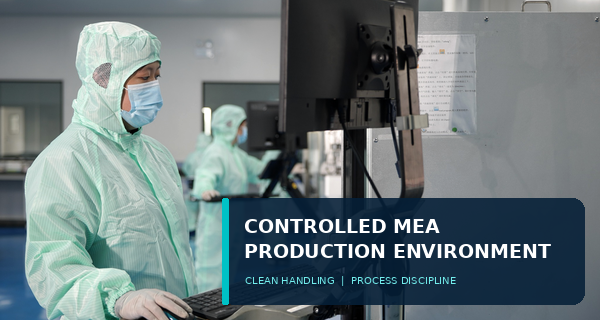
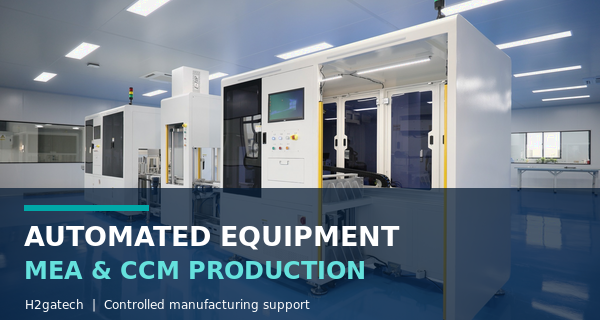
H2gatech's photographs show dedicated laboratory and production spaces, operators wearing protective garments, masks and gloves, enclosed equipment, organized workstations, and smooth floors that can be cleaned. These observations support the description controlled production environment. They do not establish a formal ISO cleanroom class or a particular temperature, humidity, particle-count, or pressure limit.
What Controlled Environment Means in MEA Manufacturing
For an MEA manufacturer, environmental control is broader than air cleanliness. It includes line clearance before a job, material identification, protected staging, defined contact surfaces, handling rules, appropriate process conditions, equipment housekeeping, segregation of accepted and suspect material, and traceable release. The required controls depend on the construction: a bare CCM, a 5-layer fuel-cell MEA, and a framed PEM-electrolyzer MEA do not share every material or risk.
Control area | Potential MEA risk | Practical control evidence |
Foreign material | Particles or fibers on a membrane, catalyst layer, GDL or seal interface | Protected handling, clean work surfaces, garments and gloves, visual checks, defined cleaning practices |
Material exposure | Moisture or temperature history may change handling behavior or dimensions of moisture-responsive materials | Defined storage, exposure and conditioning rules appropriate to the approved material |
Surface contact | Scratches, creases, punctures, catalyst-layer damage or transfer contamination | Approved tools, limited direct contact, protected carriers and clear handling points |
Mix-up and orientation | Wrong membrane, catalyst side, GDL grade, frame or drawing revision | Lot identification, labels, line clearance, orientation marks and independent confirmation where required |
Workflow and segregation | Accepted, uninspected and suspect material becoming mixed | Status identification, separated locations and documented hold or release decisions |
Process consistency | Coating, drying, joining or assembly results drifting from the qualified route | Approved instructions, suitable equipment settings, operator checks and in-process records |
Why Thin MEA Materials Need Careful Handling
An MEA combines functional layers that are thin, porous, coated, compressible, or moisture responsive. The proton-exchange membrane separates gases while conducting protons. Catalyst layers must retain the intended coverage and microstructure. GDL and MPL materials provide electrical contact and support gas and water transport. Frames and sealing features must remain aligned with the active area and cell hardware. Damage at one interface may not be obvious after all layers are assembled.
DOE-supported quality-control research has examined defects in membranes, GDLs, catalyst-coated materials, GDEs, and CCMs because small defects can affect performance or lifetime and can consume expensive material before they are detected. In the cited work, optical methods identified dust-like bright spots and local loading variation on coated materials. This does not mean every visible particle causes immediate cell failure; it shows why prevention, detection, and disposition need to be part of manufacturing control rather than left to chance.
For H2gatech's available constructions and customization options, see the membrane electrode assembly product page.
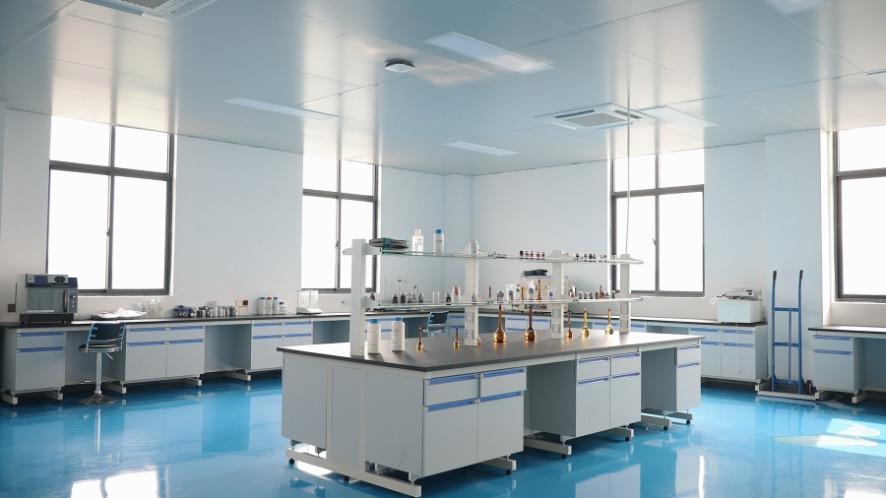
Figure 1. An organized H2gatech laboratory supports material preparation, process development and controlled technical work.
Environmental Consistency Supports Process Consistency
Catalyst-layer manufacture depends on more than the nominal catalyst loading. NREL research links ink formulation, dispersion, coating method, drying conditions, substrate and layer morphology to electrode variability and electrochemical performance. A production environment cannot replace a qualified formulation or process window, but it can prevent avoidable day-to-day changes from becoming hidden process variables.
The practical requirement is to define the conditions that matter for a particular route, monitor them where required, and document what happens outside the approved window. A supplier should not copy one universal temperature or humidity limit across every membrane, ink, adhesive, GDL or seal. The appropriate limit must come from the material requirements, process development and validation for the actual product.
What the H2gatech Factory Photographs Show
The photographs provide direct evidence of a dedicated laboratory and production area, personnel using protective clothing and gloves, operators supervising enclosed equipment, and an orderly arrangement of workstations. These features support disciplined handling and a clear separation between technical work areas and general traffic. They also show that operator oversight remains part of the process even when enclosed or automated equipment is used.
H2gatech engineering observation: for a custom order, environmental discipline starts before the material enters equipment. The drawing revision, membrane grade, catalyst identity and loading basis, GDL or PTL, frame or adhesive, active area, orientation and acceptance plan should be confirmed before staging. A clean room cannot correct the wrong material or an obsolete drawing; environment control and specification control must work together.
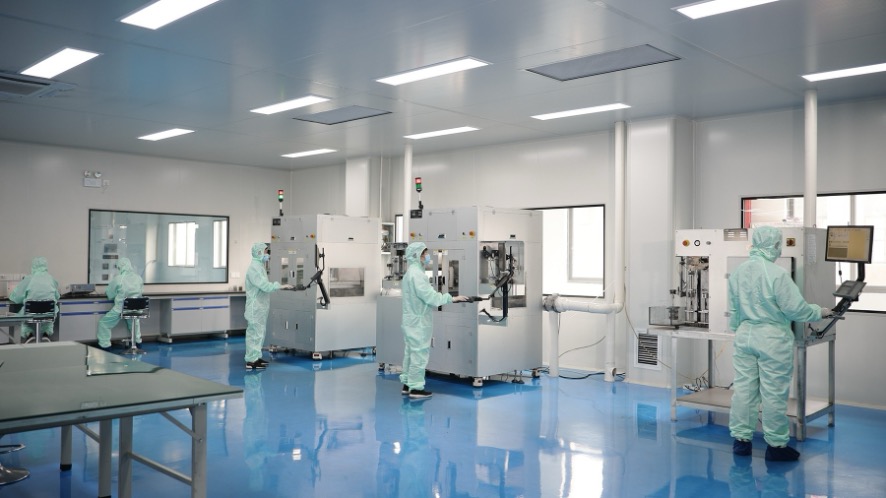
Figure 2. H2gatech personnel work across multiple supervised equipment stations in a controlled production environment.
From Material Receipt to Protected Packaging
Stage | Controlled action | Why it matters |
1. Receipt and storage | Confirm material identity, lot, condition, supplier documents and applicable storage requirements. | Prevents an unapproved or compromised input from entering production. |
2. Job preparation | Release the current drawing, BOM, work instruction, inspection plan and required tooling. | Creates one controlled definition of the product and route. |
3. Line clearance and staging | Remove unrelated materials, identify status, protect surfaces and stage only the approved quantity. | Reduces mix-up, contamination and unnecessary exposure. |
4. Controlled processing | Follow the approved handling, equipment and process conditions; record required checks and deviations. | Keeps relevant variables within the qualified route. |
5. Inspection and disposition | Inspect agreed characteristics and separate accepted, suspect, rework and rejected material. | Prevents uncertain material from moving forward without a decision. |
6. Packaging and release | Use protective packaging, product identification, lot traceability and agreed documentation. | Preserves the approved condition through shipment and customer receipt. |
Environment Control Does Not Replace Inspection
Preventive controls reduce risk, but they cannot prove every characteristic of a finished MEA. The release plan may include appearance, dimensions, active-area position, layer orientation, membrane or frame damage, thickness or mass, catalyst-loading verification by an agreed method, electrical checks, leak testing, packaging review, lot traceability, and electrochemical evaluation. The relevant method, sampling and acceptance limit should be agreed for the project.
Likewise, final inspection cannot always recover the history of a hidden interface. A particle removed after coating, an uncontrolled material substitution, or an incorrect conditioning history may not be fully visible at final release. This is why robust MEA quality combines prevention, in-process control, final inspection and traceable records rather than relying on a single end-of-line check.
For application-specific fuel-cell constructions, review H2gatech's MEA for hydrogen fuel cells.
For electrolysis constructions, review H2gatech's MEA for PEM water electrolysis.
Buyer Checklist for Reviewing the Production Environment
Review area | Question to ask |
Scope | Which materials and production stages are covered by the controlled area and handling rules? |
Environment | Which conditions are controlled or monitored for this product, and what approved limits apply? |
Personnel | What gowning, glove, hygiene and training rules apply before operators handle exposed MEA materials? |
Material flow | How are incoming, staged, accepted, suspect and rejected materials identified and separated? |
Cleaning and maintenance | How are work surfaces, tools and equipment cleaned, released and maintained? |
Traceability | Can the supplier link the shipped product to material lots, drawing revision, process route and inspection results? |
Deviations | How are environmental excursions, contamination events and nonconforming material contained and reviewed? |
Evidence | Which records, photographs, inspection results or audit documents can be shared without exposing confidential processes? |
Information to Send for a Custom MEA Review
· Application, cell hardware, target current-density range and duty cycle.
· Dimensioned drawing with active area, outer geometry, holes, datums, orientation and required tolerances.
· MEA architecture: CCM, 3-layer, 5-layer, framed, sealed or another defined construction.
· Membrane, anode and cathode catalyst, loading value and basis, GDL or PTL, frame, adhesive and gasket interface.
· Any customer-mandated handling, cleanliness, storage, packaging or traceability requirements.
· Sample quantity, evaluation protocol, inspection method, sampling plan, acceptance criteria and required documents.
For company background and engineering focus, visit About H2gatech.
Frequently Asked Questions
Does controlled production environment mean an ISO-classified cleanroom?
Not automatically. A controlled environment can include defined handling, cleaning, material flow, environmental conditions and records without carrying an ISO cleanroom classification. If a formal class is required, request the current verified classification and scope.
Why do MEA materials need protection from particles and contact?
Membranes and catalyst-coated surfaces can be thin and sensitive to punctures, scratches, creases and foreign material. GDLs, MPLs, frames and seal interfaces also depend on correct surface condition and alignment. Prevention is usually less costly than discovering damage after assembly.
Should every MEA use the same temperature and humidity limits?
No. Suitable conditions depend on the membrane, catalyst ink, adhesive, GDL or PTL, process route and qualified work instruction. A buyer should ask for product-relevant controls rather than assume one universal limit.
Can final inspection detect every contamination or handling problem?
No. Some defects are visible or measurable, while others may be hidden inside interfaces or may affect later durability. Effective quality control combines prevention, in-process checks, final inspection and traceability.
What evidence should a buyer request?
Ask for evidence that matches the risk: current drawings and instructions, material-lot records, environmental or process records where applicable, in-process and final inspection results, deviation status, packaging requirements and agreed certificate fields.
Discuss a Controlled Custom MEA Project
H2gatech supports customized MEA and CCM projects for PEM fuel cells, PEM water electrolysis, research and specialized electrochemical applications. Send your drawing, material choices, catalyst-loading basis, operating conditions, quantity, handling requirements and acceptance plan so the engineering team can align the product specification with the manufacturing route and quality records. Contact H2gatech to review a controlled sample and production plan.
Technical References
• U.S. DOE - In-Line Quality Control of Polymer Electrolyte Membrane Materials - research on defects and in-line inspection of membranes, GDLs, catalyst-coated materials, GDEs and CCMs.
• NREL - Material-Process-Performance Relationships in PEM Catalyst Inks and Coated Layers - relationships among ink formulation, coating and drying conditions, layer morphology, variability and electrochemical performance.
• Chemours - Nafion Sulfonic Membranes - official information on PFSA membrane types and grades used in electrochemical applications.