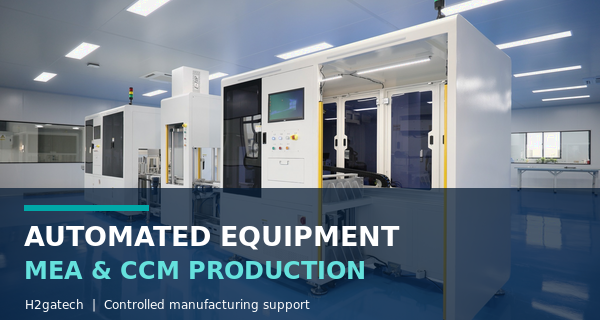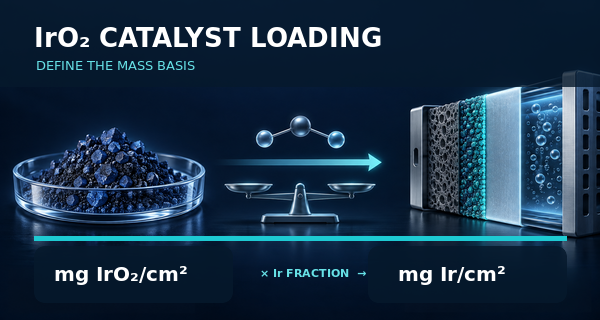

Automated Equipment for Consistent MEA & CCM Production
Automated equipment can make membrane electrode assembly production more repeatable, but automation is not a substitute for an approved specification, qualified materials, operator oversight, inspection, and electrochemical validation. Its value is practical: once an MEA or catalyst-coated membrane process window is defined, equipment can reproduce programmed actions, sequence steps consistently, record operating information, and reduce unnecessary direct handling.
The photographs in this article show H2gatech's enclosed production equipment, operator interfaces, transfer sections, signal lights, and trained personnel working in a controlled production environment. They support a factual description of equipment-assisted, supervised manufacturing. They do not establish the exact function of every station or prove a particular cleanroom grade, tolerance, production capacity, or inspection system.
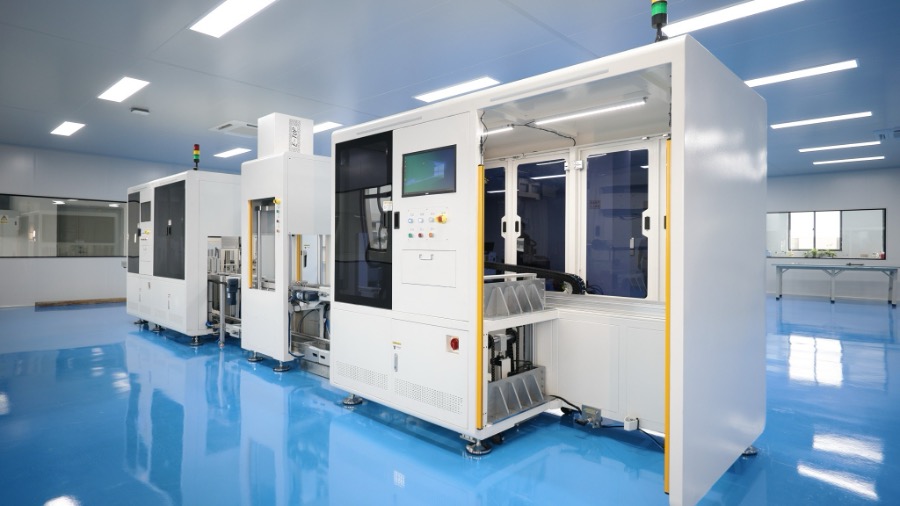
Figure 1. Enclosed production equipment and material-transfer sections in H2gatech's controlled manufacturing area.
Why MEA and CCM Consistency Is a Manufacturing Challenge
A CCM combines a proton-exchange membrane with functional catalyst layers on both sides. A finished MEA may also include gas-diffusion layers, frames, or sealing components. Small changes in material condition, catalyst ink, coating or joining history, alignment, pressure, time, temperature, handling, or storage can affect dimensions, interfaces, transport behavior, resistance, and final cell performance.
DOE-supported manufacturing research treats these links as a material-process-performance problem. Work at NREL has studied how ink properties and coating parameters influence electrode structure, and how scalable coating and metrology can connect material processing to device performance. The implication for buyers is straightforward: consistent MEAs require control of both the design inputs and the way approved inputs move through production.
For available constructions and customization fields, see H2gatech's membrane electrode assembly product page.
What Automation Can Control—and What Still Requires Engineering Judgment
Control area | Equipment contribution | Human / engineering decision |
Recipe or setup | Calls up approved programmed settings and sequences where the station supports them. | Select the correct drawing revision, materials, tooling, and approved process window. |
Motion and positioning | Repeats defined movement, placement, or transfer actions more consistently than ad-hoc manual handling. | Confirm datums, orientation, fixture condition, and the tolerance actually required by the design. |
Time and sequence | Executes timed stages and order of operations consistently. | Determine which time or sequence is technically suitable for the specific materials and architecture. |
Status and alarms | Displays operating state and can flag selected abnormal conditions. | Decide whether to stop, quarantine, investigate, rework, or reject affected material. |
Production records | Can capture recipe identity, timestamps, status, and selected process data when configured. | Define which records are required for traceability and customer documentation. |
Inspection handoff | Can route parts to the next defined step and support consistent sample identification. | Choose the relevant visual, dimensional, loading, electrical, leak, or performance checks. |
What the H2gatech Equipment Photos Demonstrate
The equipment photographs show several features that matter during supplier review: enclosed stations, computer or touch interfaces, visible emergency controls, signal lights, transfer areas, organized spacing, and operators supervising the equipment. Together, these features indicate a manufacturing approach in which programmed equipment and trained personnel work together rather than treating automation as a fully unattended black box.
H2gatech engineering observation: automation is most useful after a custom MEA specification has been translated into a controlled production package. That package should connect the customer drawing and bill of materials to the current work instruction, approved settings, material identities, in-process checks, final inspection, and packaging requirements. A machine recipe without the correct product revision is not process control.
Operator Interfaces Support Repeatable Execution and Review
A production interface can help an operator select a defined program, view status, follow a sequence, and respond to alarms or prompts. When record functions are configured, it can also support documentation of the recipe, time, operator, status, and selected process values. The specific data available depend on the equipment and project, so buyers should request only verified record fields rather than assuming every station has complete digital traceability.
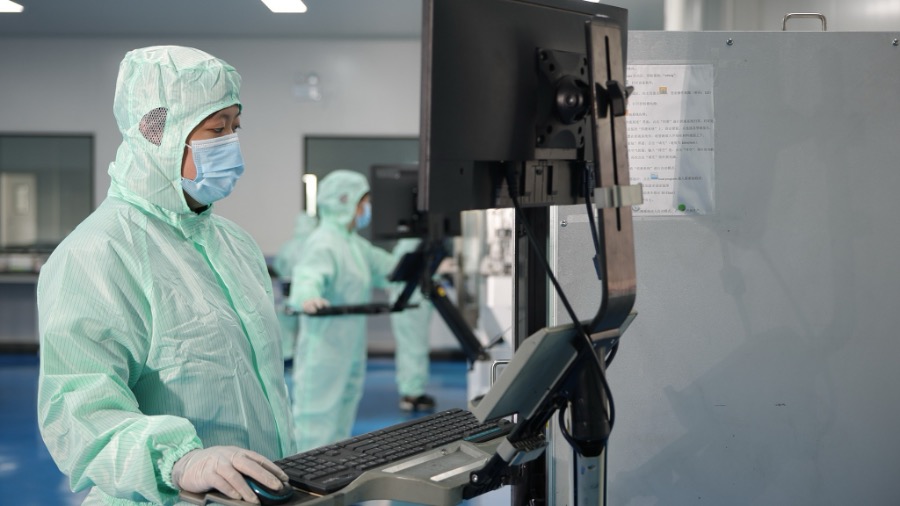
Figure 2. A H2gatech operator supervises equipment through a production interface; human confirmation and response remain part of controlled operation.
The operator remains responsible for tasks that equipment cannot judge from a program alone: confirming the material and lot, checking anode/cathode orientation, verifying the correct fixture and drawing, inspecting visible condition, identifying unusual behavior, and escalating deviations. Well-designed automation makes these decisions easier to execute consistently; it does not eliminate them.
Automation Does Not Make Every MEA Architecture the Same
A CCM, a 3-layer MEA, a 5-layer MEA with GDLs, and a framed or sealed assembly have different interfaces and handling risks. Fuel-cell MEAs and PEM-water-electrolysis MEAs also use different catalyst and transport-layer systems. Equipment settings, fixtures, transfer methods, and inspection points therefore need to follow the approved architecture. One generic program should not be assumed to cover every membrane, catalyst layer, GDL, seal, geometry, or application.
For fuel-cell constructions, see H2gatech's MEA for hydrogen fuel cells.
For electrolysis constructions, see H2gatech's MEA for PEM water electrolysis.
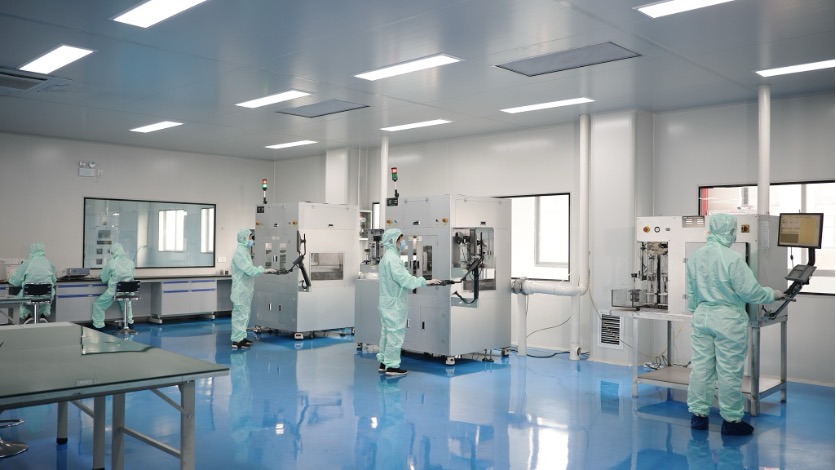
Figure 3. H2gatech personnel work across multiple equipment stations in a controlled production environment.
A Practical Automation and Quality-Control Workflow
Stage | Controlled information | Purpose |
1. Release | Current drawing, construction, material list, process revision, acceptance plan | Prevent an obsolete or incomplete specification from reaching the floor. |
2. Material confirmation | Material grade, lot identity, storage condition, orientation | Make sure the approved input—not merely a similar material—is used. |
3. Setup | Program, fixture, tooling, parameter window, equipment status | Create a controlled starting condition before processing valuable membrane and catalyst. |
4. First-piece review | Dimensions, alignment, visible condition, required in-process results | Confirm setup before releasing the remaining batch. |
5. Monitored production | Status, alarms, selected process records, operator observations | Detect drift or abnormal behavior early and contain affected material. |
6. Final release | Agreed inspection, identification, traceability, documentation, packaging | Link the shipped MEA or CCM to the approved order requirements. |
Why In-Process Detection Matters
A defect found only after final assembly may already contain expensive catalyst, membrane, GDL, frame material, and processing time. DOE research on in-line quality control has therefore focused on detecting defects in membranes, GDLs, catalyst-coated materials, GDEs, and CCMs during manufacturing. In-line methods can reduce scrap and support faster response, but a buyer should not assume a supplier uses a particular sensor or inspection technology unless it is confirmed for that production route.
For a custom H2gatech project, the inspection plan should be agreed with the quotation or sample approval. Depending on the product, relevant controls may include appearance, dimensions, active-area position, layer orientation, surface condition, thickness or mass, catalyst-loading verification by an agreed method, electrical checks, leak testing, and electrochemical evaluation. The method, sampling, limit, and record need to be defined; the word automated does not define acceptance.
Buyer Checklist: Evaluating Automated MEA Production
Review area | Question to ask |
Specification control | Can the supplier link the latest drawing, layer structure, BOM, loading basis, and acceptance plan to the production instruction? |
Setup control | How are the correct program, fixture, material, orientation, and parameter window confirmed before processing? |
First-piece approval | Which checks release the setup before the rest of the batch is produced? |
Material traceability | Which membrane, catalyst, GDL/PTL, frame, adhesive, or other material lots are recorded? |
Deviation handling | How are alarms, abnormal conditions, suspect material, and authorized rework controlled? |
Inspection | Which in-process and final checks are used, and what method, sampling, limits, and records apply? |
Change control | Will a material, drawing, program, tooling, or process change be reviewed before use? |
Information to Send for a Custom MEA or CCM Review
·Application, cell hardware or flow-field information, target power or current-density range, and duty cycle.
·Dimensioned drawing showing active area, outer geometry, holes, datums, orientation, and required tolerances.
·MEA architecture: CCM, 3-layer, 5-layer, framed, sealed, or another defined construction.
·Membrane, anode/cathode catalyst, loading value and basis, GDL or PTL, frame, adhesive, and gasket interface.
·Nominal and maximum operating temperature, pressure, humidity or water quality, gas conditions, and differential pressure.
·Sample quantity, evaluation cell, conditioning and test protocol, acceptance criteria, and required documents.
For H2gatech's company background and engineering focus, visit About H2gatech.
Frequently Asked Questions
Does automated equipment guarantee identical MEAs?
No. Automation can improve repeatability of defined actions, but material variation, setup, tooling, maintenance, environment, operators, inspection, and measurement uncertainty still matter. Consistency must be demonstrated through controlled records and agreed acceptance results.
Is H2gatech claiming fully unmanned MEA production?
No. The factory photographs show equipment-assisted production with operators at interfaces and stations. This article intentionally describes supervised automation, not a fully unmanned line.
Can automated equipment support custom or smaller batches?
It can, provided the equipment, tooling, setup, and approved process window are suitable for the geometry and materials. A first-piece review and revision-controlled instruction are especially important during changeover. Specific capability should be confirmed for each project.
Does the photographed area have a stated ISO cleanroom class?
This article makes no ISO cleanroom-class claim. It uses controlled production environment because the photographs show dedicated rooms, protective garments, organized work areas, and enclosed equipment. Request verified documentation separately if a formal classification is required.
Which records should a buyer request?
Request the records needed to prove conformity: current drawing and BOM revision, relevant material lots, approved setup or recipe identity, required in-process and final inspection results, deviation status, product identification, and any agreed certificate fields.
Discuss a Controlled MEA or CCM Production Project
H2gatech supports customized MEA and CCM projects for PEM fuel cells, PEM water electrolysis, research, and specialized electrochemical applications. Send your drawing, intended construction, material preferences, catalyst-loading basis, operating conditions, sample quantity, and acceptance method so the engineering team can review the fit between the specification, equipment route, inspection plan, and production records. Contact H2gatech to define a controlled sample and production plan before manufacturing begins.
Technical References
• U.S. DOE — In-Line Quality Control of Polymer Electrolyte Membrane Materials — manufacturing-defect detection and automated in-line quality-control research for membranes, GDLs, catalyst-coated materials, GDEs, and CCMs.
• NREL — Roll-to-Roll Advanced Materials Manufacturing Lab Collaboration — work connecting scalable multilayer coating, metrology, characterization, process understanding, and MEA scale-up.
• NREL — Material-Process-Performance Relationships in PEM Catalyst Inks and Coated Layers — relationships among catalyst-ink properties, coating parameters, electrode structure, variability