
IrO2 Catalyst Loading: mg IrO2 cm2 vs mg Ir cm2
Why the Loading Basis Matters
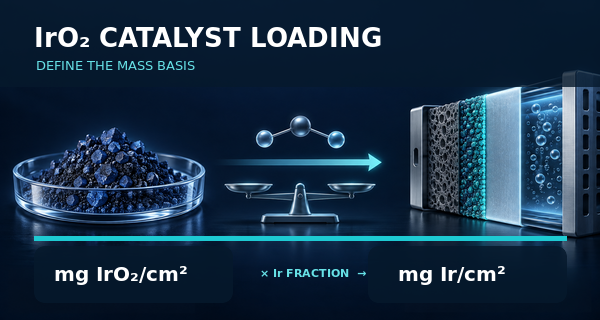
Iridium oxide is widely used for the oxygen-evolution reaction at PEM water-electrolyzer anodes. The U.S. Department of Energy's H2NEW program reports anode loadings and catalyst activity on an Ir-metal basis, for example mgIr/cm² and A/gIr, because that basis enables a direct comparison of iridium utilization across different catalyst compositions. The same source also notes that electrocatalyst evaluation must account for metal or oxide content and catalyst structure.
A powder-mass basis is still useful for manufacturing because it determines how much material enters an ink and how much dry powder is deposited. The problem appears when one party quotes powder mass and another assumes Ir-metal mass. A difference of roughly 14.3% already exists between pure stoichiometric IrO2 powder and its contained Ir mass, before considering moisture, non-stoichiometry, support, impurities, or binder.
For the application context, see H2gatech's PEM electrolyzer solutions.
Four Loading Expressions That Buyers May Encounter
Expression | What it means | What must also be defined |
mg IrO2 powder/cm² | Mass of the supplied IrO2 powder divided by the stated coated area. | Requires the catalyst grade and certified Ir content. |
mg total oxide/cm² | Total mass of all oxide components per coated area. | Can include more than IrO2 in a mixed or supported catalyst. |
mg Ir/cm² | Mass of elemental iridium contained in the catalyst per coated area. | Best for comparing Ir use, but does not define total layer mass. |
mg dry layer solids/cm² | Dry catalyst-layer mass, potentially including catalyst, ionomer or binder, support, and additives. | Not an Ir loading unless each component fraction is stated. |
The Theoretical Conversion for Stoichiometric IrO2
Using the CIAAW standard atomic weight of iridium, 192.217, and 15.9994 as a representative oxygen value within CIAAW's published interval, the molar mass of IrO2 is approximately 224.216 g/mol. The theoretical Ir mass fraction is:
Ir mass fraction = 192.217 ÷ (192.217 + 2 × 15.9994) = 0.8573
mg Ir/cm² = mg IrO2/cm² × 0.8573
IrO2 powder loading (mg/cm²) | Theoretical Ir loading (mgIr/cm²) |
0.50 | 0.429 |
1.00 | 0.857 |
1.50 | 1.286 |
2.00 | 1.715 |
2.50 | 2.143 |
3.00 | 2.572 |
Important: This table is a stoichiometric calculation, not a certificate value. Commercial material may contain bound or adsorbed water, a different oxygen-to-metal ratio, residual components, a support, or other constituents. Use the supplier's lot-specific Ir assay when procurement, coating, and acceptance quantities must match.
Use the Certificate of Analysis for Commercial Powder
The most reliable conversion is based on the certified elemental Ir mass fraction for the specific catalyst lot:
mg Ir/cm² = mg catalyst powder/cm² × certified Ir mass fraction
If the certificate reports 80.0 wt% Ir, for example, 2.00 mg of powder per square centimetre contains 1.60 mgIr/cm². Conversely, a target of 2.00 mgIr/cm² requires 2.50 mg powder/cm² at 80.0 wt% Ir. The calculation should keep enough significant figures for process control, while the final specification should use tolerances that the measurement method can realistically verify.
Worked Example: Why “2 mg/cm²” Is Ambiguous
Case | Stated loading | Composition basis | Result |
A | 2.00 mg IrO2 powder/cm² | Pure stoichiometric IrO2 | 1.715 mgIr/cm² (theoretical) |
B | 2.00 mg catalyst powder/cm² | 80.0 wt% certified Ir | 1.600 mgIr/cm² |
C | 2.00 mgIr/cm² | 80.0 wt% certified Ir | 2.500 mg powder/cm² required |
D | 2.00 mg dry layer solids/cm² | Catalyst plus ionomer/additives | Cannot calculate without composition |
Cases A through D could all be written informally as “2 mg/cm²,” yet they describe different electrodes. This is why a quotation and drawing should spell out the mass basis rather than relying on a shorthand note.
Define the Area and Electrode Side
A mass-per-area value is incomplete until the denominator is defined. State whether the area is the active area, the catalyst-coated area, or the full substrate area. If edge overcoat, masking, segmented coating, or a non-rectangular geometry is used, provide a drawing and the area calculation.
Also identify the anode and cathode separately. In PEM water electrolysis, IrO2 is associated with the oxygen-evolution anode; the cathode commonly uses a different catalyst system. Do not add both sides together unless the document clearly says “total two-sided loading.” A supplier should be able to trace each side to its own catalyst grade and loading requirement.
H2gatech offers customizable membrane, catalyst-loading, and active-area options for a PEM water electrolysis membrane electrode assembly.
Loading Is Not the Same as Catalyst-Layer Formulation
The Ir loading identifies how much iridium is present, but it does not fully define the electrode. Ionomer-to-catalyst ratio, solvent system, solids content, dispersion method, coating route, drying, layer thickness, porosity, and interface with the porous transport layer all influence utilization and transport. Two catalyst layers with the same mgIr/cm² can therefore deliver different voltage, resistance, gas transport, and durability.
H2gatech engineering note: When an inquiry states “IrO2, 2–3 mg/cm²,” the first clarification should be whether this means IrO2 powder or contained Ir metal. The next checks are catalyst grade and assay, active area, anode-side coating, membrane, electrode architecture, operating window, and how loading will be accepted. Clarifying these items before coating avoids a sample that is dimensionally correct but chemically different from the buyer's intended design.
For broader MEA architecture and customization context, review H2gatech's membrane electrode assembly solutions.
How Catalyst Loading Can Be Verified
There is no single universal acceptance method for every CCM or electrode. The buyer and manufacturer should agree on a method that matches the substrate, loading range, sample size, and required uncertainty. A mass-balance method can be practical when tare measurements and instrument resolution are adequate. Element-specific methods such as calibrated X-ray fluorescence can support non-destructive checks, while chemical analysis such as ICP may be used when a destructive reference measurement is appropriate. Any analytical result depends on sampling, calibration, preparation, and the stated calculation basis.
For routine production, the acceptance plan may combine incoming catalyst certification, controlled ink and coating records, in-process mass control, dimensional inspection, and periodic analytical verification. The exact combination should be documented rather than implied by a generic “loading test” requirement.
IrO2 Catalyst Loading RFQ Checklist
RFQ field | Information to provide | Why it matters |
Catalyst | Supplier, commercial grade, supported or unsupported form | Identifies the material being quoted. |
Certified composition | Ir wt%, oxide or powder basis, moisture/volatile basis if reported | Provides the correct conversion factor. |
Loading | Numeric target, tolerance, unit, and mass basis | Separates mg powder/cm² from mgIr/cm². |
Area | Active area, coated area, geometry, and masking zones | Defines the denominator and total catalyst quantity. |
Electrode side | Anode or cathode; single-side or total two-sided value | Prevents side-to-side misinterpretation. |
MEA design | Membrane, CCM/PTE architecture, ionomer requirement, PTL interface | Connects loading to a buildable electrode. |
Verification | CoA fields, calculation formula, sampling, method, acceptance limits | Creates one approval basis for both parties. |
Test conditions | Water quality, temperature, pressure, current density, conditioning, durability protocol | Makes performance data comparable. |
A Practical Approval Sequence
1. Confirm the catalyst grade and obtain the current data sheet or certificate fields.
2. Choose one primary loading basis—preferably mgIr/cm² for Ir-use comparison—and state any secondary powder-mass value separately.
3. Freeze the coated area, side designation, membrane, layer architecture, and drawing revision.
4. Agree on the conversion formula, assay source, measurement method, sampling plan, and tolerance.
5. Evaluate the sample under a defined electrolyzer protocol; keep non-catalyst variables consistent when comparing loadings.
6. Approve the specification only after performance, durability, dimensions, and documented loading all meet the project requirement.
Frequently Asked Questions
Is 1 mg IrO2/cm² equal to 1 mgIr/cm²?
No. For stoichiometric, anhydrous IrO2, 1.00 mg IrO2/cm² contains theoretically about 0.857 mgIr/cm². Use the certified Ir assay for commercial powder.
How much IrO2 corresponds to 1 mgIr/cm²?
The theoretical value for pure stoichiometric IrO2 is about 1.167 mg IrO2/cm². A commercial powder with a lower certified Ir percentage requires more powder.
Should an RFQ use mg IrO2/cm² or mgIr/cm²?
Either can be controlled if the basis is explicit. mgIr/cm² is especially useful for comparing iridium utilization and cost across different catalyst compositions; powder mass remains important for manufacturing.
Does the same mgIr/cm² guarantee the same electrolyzer performance?
No. Catalyst structure, ionomer content, layer thickness, porosity, membrane, PTL interface, cell hardware, and operating conditions also affect performance and durability.
Specify the Loading Basis Before Requesting Samples
H2gatech supports customized PEM water-electrolysis MEAs with selectable membrane, catalyst system, loading, active area, and geometry. For a faster technical review, send the catalyst grade or desired Ir assay, loading value and mass basis, coated-area drawing, anode/cathode definition, membrane, PTL interface, operating conditions, sample quantity, and acceptance method. Contact H2gatech to align the calculation and build specification before sample production.
Technical References
• U.S. Department of Energy / H2NEW - Low-PGM Catalysts and Novel Supports - PEM-electrolyzer OER catalyst loading, activity metrics, and the need to account for metal/oxide content and catalyst structure.
• CIAAW - Standard Atomic Weights 2024 - standard atomic weights used for the theoretical IrO2-to-Ir mass conversion.