
IrO2 vs IrRuOx: PEM Electrolyzer Catalyst Guide
IrO2 vs IrRuOx: What Is the Difference?
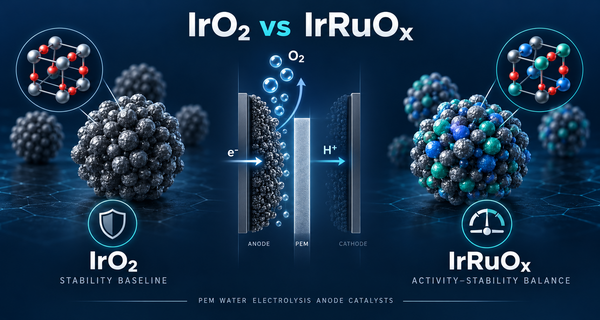
Short answer: IrO2 is the established stability-focused oxygen-evolution catalyst used at many PEM water-electrolyzer anodes. IrRuOx is a broad family of iridium-ruthenium mixed oxides developed to combine ruthenium's high oxygen-evolution activity with enough stabilization for acidic, high-potential operation. IrRuOx is not automatically better: its result depends on the Ir/Ru ratio, oxide structure, manufacturing route, electrode formulation, loading basis, and actual stack conditions.
For purchasing, the correct question is not simply “IrO2 or IrRuOx?” It is which qualified catalyst-layer design meets the required efficiency, degradation, precious-metal use, and lifetime target in the customer's membrane, porous-transport layer, cell hardware, and operating window.
Why the Anode Catalyst Choice Matters
In a PEM water electrolyzer, water is oxidized at the anode to form oxygen, protons, and electrons. The anode therefore operates at strongly oxidizing potentials in an acidic ionomer environment. Many otherwise active materials dissolve or restructure under these conditions. The U.S. Department of Energy's H2NEW program identifies unsupported iridium or iridium oxide as the standard PEM-electrolyzer anode catalyst because it offers a practical balance between oxygen-evolution activity and stability, while also noting the high activity and dissolution challenge of ruthenium oxide.
For the full cell and stack context, see H2gatech's PEM electrolyzer solutions.
IrO2 vs IrRuOx at a Glance
Criterion | IrO2 | IrRuOx | Buyer action |
Material description | Iridium oxide catalyst; grade and oxidation state still matter. | Ir-Ru mixed oxide family; not one fixed compound or universal ratio. | Request the exact commercial grade and current data sheet. |
Design objective | Established activity-stability baseline for acidic OER. | Use Ru-containing chemistry to pursue higher activity or lower Ir use while retaining adequate stability. | Define the project priority before comparing products. |
Activity | Suitable OER activity; strongly dependent on surface area and electrode structure. | Ru addition can increase activity, but the gain is formulation-specific. | Compare in the same MEA and test protocol. |
Durability | Generally selected when proven acidic-OER stability is the priority. | Depends on how Ru is stabilized, composition, structure, and operating conditions. | Require relevant degradation or lifetime evidence. |
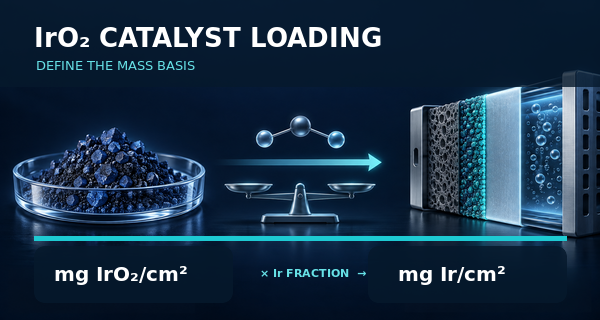
Iridium use | The catalyst's precious-metal component is Ir. | Can reduce the Ir fraction by substituting part of the metal content with Ru. | Compare mgIr/cm², not only total powder loading. |
Main RFQ risk | “IrO2” alone does not define grade, assay, surface area, or loading basis. | “IrRuOx” does not define ratio, ratio basis, phase, support, or stability. | Write a complete catalyst and electrode specification. |
What Is IrO2?
IrO2 is iridium oxide, but that name is only the beginning of a usable specification. Commercial powders can differ in iridium assay, oxygen content, hydration, crystallinity, particle size, surface area, agglomeration, impurities, and heat-treatment history. These differences influence ink processing, catalyst-layer structure, interfacial contact, initial performance, and durability.
For a buyer seeking a conservative reference material or transferring an already qualified design, an established IrO2 grade is often the clearer starting point. It should still be validated in the intended MEA rather than accepted only from a powder data sheet.
What Is IrRuOx?
IrRuOx is shorthand for an oxide system containing iridium and ruthenium. Depending on the supplier and synthesis route, it may refer to a mixed oxide, solid solution, composite, coated structure, or another engineered arrangement. The “x” indicates that the oxygen stoichiometry is not being stated as one simple fixed formula.
Ruthenium oxide is highly active for acidic oxygen evolution but can suffer rapid dissolution. Mixed-oxide development therefore aims to retain useful Ru-related activity while stabilizing the catalyst sufficiently for PEM-electrolyzer operation. Results cannot be generalized from the material name alone. For example, Heraeus reports a specific stabilized Ir-Ru oxide catalyst class with substantially higher mass activity than conventional iridium oxide; that is a product-specific claim and should not be applied to every IrRuOx powder.
Activity and Durability Must Be Evaluated Together
A lower beginning-of-life cell voltage is valuable only if the advantage remains through the required operating life. DOE-supported testing has shown the basic trade-off directly: ruthenium-containing anode materials can provide higher initial performance, while pure RuO2 can lose stability over short testing periods. A mixed oxide must therefore be evaluated through both polarization performance and a relevant durability protocol.
Engineering decision: Do not rank an anode catalyst using one initial voltage point. Compare beginning-of-life performance, degradation rate, precious-metal loading, and the same operating profile. |
“IrRuOx” Is Not a Complete Purchase Specification
At minimum, ask the supplier to define:
·Ir and Ru content, plus whether the stated ratio is atomic, molar, or by metal weight.
·Whether loading is expressed as total catalyst powder, total oxide, total PGM metal, Ir metal, or Ir plus Ru metal per square centimetre.
·Commercial grade, support or unsupported form, nominal surface area or particle information where controlled, and certificate-of-analysis fields.
·The anode layer location: catalyst-coated membrane, porous-transport electrode, or another architecture.
·Active area, coating dimensions, membrane, ionomer or binder system, heat treatment, and porous-transport-layer interface.
A similar ratio-definition problem occurs with PtRu/C. See PtRu/C Catalyst Ratio: Atomic vs Weight Ratio for a worked explanation of ratio bases.
Do Not Compare Equal mg/cm² Values Until the Basis Matches
A statement such as “2 mg/cm²” is ambiguous. Two electrodes can carry the same total powder mass yet contain different Ir mass because IrO2 and IrRuOx have different compositions. Conversely, matching mgIr/cm² can require different total catalyst-layer masses. This changes layer thickness, ionomer demand, pore structure, and interface behavior.
Loading basis | Meaning | Important limitation |
mg catalyst powder/cm² | Mass of the supplied powder deposited per active area. | May include oxygen, support, water, or other non-PGM content depending on the product definition. |
mg total oxide/cm² | Combined oxide mass per active area. | Still does not state how much Ir or Ru is present. |
mgIr/cm² | Iridium-metal mass per active area. | Useful for Ir utilization comparisons; requires an Ir assay or defined composition. |
mg(Ir+Ru)/cm² | Total Ir plus Ru metal mass per active area. | Must be paired with an Ir:Ru ratio and ratio basis. |
H2gatech engineering note: When an RFQ states only “IrRuOx, 2 mg/cm²,” the quotation basis is not yet controlled. The catalyst identity, Ir/Ru ratio and basis, active area, coated side, and acceptance method should be confirmed before sample production.
When IrO2 May Be the Better Starting Point
·The existing MEA or stack design has already qualified a specific IrO2 grade.
·Durability evidence and process transfer are higher priorities than minimizing Ir content in the first sample round.
·The customer needs a clear reference electrode before screening alternative catalysts.
·The supplier can provide consistent assay, traceability, and data for the selected grade.
When IrRuOx May Be Worth Evaluating
·The project has a defined target to reduce Ir loading or improve mass activity.
·The supplier identifies the Ir/Ru ratio, ratio basis, material structure, and loading basis clearly.
·The customer can run matched durability testing under its real current-density and operating profile.
·A validated mixed-oxide product has evidence of sufficient stability in comparable MEA or stack conditions.
PEM Electrolyzer Anode Catalyst RFQ Checklist
RFQ field | Information to provide | Why it matters |
Application | PEM electrolyzer, cell or stack format, development stage | Prevents data from unrelated OER systems being treated as equivalent. |
Catalyst identity | IrO2 or exact IrRuOx grade; supported or unsupported | Defines what material is actually being quoted. |
Composition | Ir/Ru ratio and whether it is atomic/molar or metal weight | Avoids chemically different interpretations. |
Loading | Value, unit, basis, active area, and coated side | Makes powder and PGM quantities comparable. |
MEA architecture | Membrane grade/thickness, CCM or PTE, PTL and seal interface | Controls the catalyst-layer environment. |
Operating window | Temperature, pressure, water quality, current density, dynamic duty | Defines the relevant performance and corrosion stress. |
Acceptance | CoA, dimensions, loading method, polarization protocol, durability target | Creates a common sample-approval basis. |
How to Qualify an IrO2 or IrRuOx Electrode
A fair comparison holds the non-catalyst variables constant. Use the same active area, membrane, layer architecture, ionomer content or optimization method, coating process, PTL, compression, water quality, temperature, pressure, conditioning, and measurement procedure. Record both performance and degradation rather than comparing supplier charts produced in different cells.
1. Verify the incoming catalyst grade, Ir/Ru assay, lot traceability, and agreed certificate fields.
2. Confirm the dry loading and calculation basis using an agreed analytical or mass-control method.
3. Measure polarization and resistance after the same conditioning procedure.
4. Run durability testing at the relevant current density and dynamic profile; track cell voltage and degradation rate.
5. Inspect the catalyst layer and membrane after testing when failure analysis is required.
For customizable membrane, catalyst-loading, and active-area options, view H2gatech's membrane electrode assembly for PEM water electrolysis.
Membrane selection must be validated with the catalyst layer. See Nafion N115 vs N117: Thickness, Uses, and Selection.
Frequently Asked Questions
Is IrRuOx always better than IrO2?
No. Some engineered IrRuOx catalysts can improve activity or reduce Ir use, but their durability and electrode compatibility are product- and system-specific. IrO2 remains an important stability-focused baseline.
Which catalyst is generally more durable in acidic PEM electrolysis?
IrO2 is generally selected for its established balance of acidic-OER activity and stability. A specific IrRuOx material may achieve suitable durability, but this must be demonstrated in relevant testing.
How should an Ir/Ru ratio be written in an RFQ?
State both the numerical ratio and its basis, for example Ir:Ru = 80:20 atomic, or Ir:Ru = 80:20 by metal weight. Also request the certified Ir and Ru assay.
Can two catalysts be compared at the same 2 mg/cm² loading?
Only after confirming that 2 mg/cm² refers to the same basis. Total powder, total oxide, total PGM, and Ir-metal loadings are not interchangeable.
Request an IrO2 or IrRuOx MEA Review
H2gatech supports customized PEM water-electrolysis MEAs with selectable membrane, catalyst system, loading, active area, and geometry. To request a technical review, send the application, drawing, catalyst preference or comparison target, Ir/Ru ratio basis, loading basis, membrane, PTL, operating conditions, sample quantity, and validation method. Contact H2gatech to discuss a controlled sample specification before production.
Technical References
• Heraeus - PEM Electrolysis Catalysts - supplier information on Ir oxide and a specific stabilized Ir-Ru oxide catalyst class.
• U.S. DOE / Argonne - H2NEW Low-PGM Catalysts Workshop - activity and stability constraints for PEM-electrolyzer OER catalysts.
• U.S. DOE - High-Efficiency PEM Water Electrolysis - testing of RuO2, Ru-containing materials, and Ir-based anode catalysts.