
3 Layer MEA vs 5 Layer MEA: What Is the Difference?
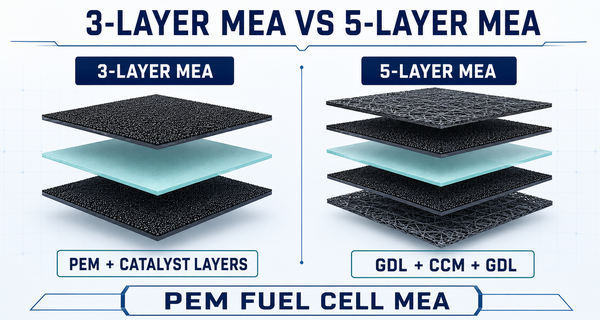
The difference between a 3-layer MEA and a 5-layer MEA is whether the gas diffusion layers are included. In common PEM fuel cell purchasing language, a 3-layer MEA contains a proton exchange membrane with an anode catalyst layer and a cathode catalyst layer. This structure is also commonly called a catalyst-coated membrane, or CCM. A 5-layer MEA adds one gas diffusion layer on each side of that three-layer core. The right format depends on how much control you need over GDL selection, sealing, compression, handling, and cell assembly.
3-Layer MEA vs 5-Layer MEA at a Glance
Parameter | 3-layer MEA | 5-layer MEA | Why it matters |
Layer structure | Anode catalyst layer + PEM + cathode catalyst layer | Anode GDL + 3-layer core + cathode GDL | The five-layer format includes gas diffusion media. |
Common name | Often called a CCM | Often called a five-layer MEA | Supplier terminology is not perfectly standardized. |
GDL selection | Selected separately by the customer or assembler | Specified and supplied as part of the assembly | Separate selection offers flexibility; integration simplifies sourcing. |
Handling | Thin catalyst-coated membrane requires careful handling | GDLs support and protect the coated membrane faces | Handling requirements affect laboratory and production workflows. |
Cell assembly | GDLs must be aligned separately | Major electrochemical layers arrive together | Integration can reduce loose-part alignment work. |
Typical reason to choose | Maximum GDL and sealing flexibility | Convenient, matched component package | The best format depends on the cell design and process. |
What Is a 3-Layer MEA?
A three-layer structure places the proton exchange membrane between the anode and cathode catalyst layers. Because the catalyst is coated directly on the membrane, many engineers and suppliers use “3-layer MEA” and “CCM” for the same purchasable component. It does not normally include the two GDLs or a seal frame unless the quotation and drawing say otherwise.
What Is a 5-Layer MEA?
A five-layer MEA combines the three-layer CCM with an anode GDL and a cathode GDL. These porous layers distribute reactant gases, conduct electrons and heat, support water management, and help protect the CCM during cell assembly. The two GDLs may use the same grade or different specifications according to the anode and cathode requirements.
When Should You Choose a 3-Layer MEA?
Choose a 3-layer MEA when the membrane and catalyst coating are the main items you want the supplier to integrate, while your team retains control of the diffusion media and final cell build. It is often a practical format for research, material screening, and proprietary stack designs.
· You need to compare several GDL grades with the same CCM.
· Your stack design already has a qualified GDL and compression target.
· GDLs, gaskets, and seal frames are assembled by separate processes.
· You need direct access to the CCM for inspection or diagnostic testing.
When Should You Choose a 5-Layer MEA?
Choose a 5-layer MEA when you want the GDLs specified together with the CCM and delivered as a more integrated assembly. This can make component handling and repeat assembly more straightforward, provided that the GDL grades and compression behavior match the cell hardware.
· You want fewer loose electrochemical components during assembly.
· The anode and cathode GDL specifications are already known.
· Handling support for the catalyst-coated membrane is important.
· You want one supplier to coordinate the CCM and GDL configuration.
Does a 5-Layer MEA Perform Better?
Not automatically. “Five-layer” describes the supplied structure, not a guaranteed performance level. A three-layer MEA can deliver excellent performance when paired with suitable GDLs and assembled correctly. A five-layer MEA can underperform if the selected GDL, microporous layer, compression, sealing, or operating conditions do not match the cell. Compare complete designs under the same test protocol rather than ranking them by layer count alone.