
SIGRACET 28 BC and Toray TGP H 060 GDL Comparison
SIGRACET 28 BC vs Toray TGP-H-060: Which GDL Should You Choose?
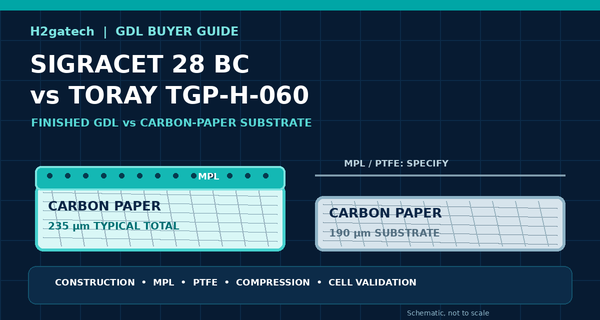
SIGRACET 28 BC and Toray TGP-H-060 are both used in discussions about PEM fuel cell gas diffusion media, but the product names do not describe the same delivered construction. SGL Carbon publishes SIGRACET 28 BC as a fully treated gas diffusion layer with a carbon-paper backing, hydrophobic treatment, and a microporous layer. Toray’s public TGP-H data sheet describes TGP-H-060 as a 0.19 mm carbon-paper grade and does not define a PTFE treatment or MPL as part of that grade name.
The practical conclusion is simple: 28 BC can be compared with a finished TGP-H-060-based GDL only after the Toray construction is fully specified. A quotation that says only “TGP-H-060” may refer to the base carbon paper or to a converted version with added PTFE and an MPL. Those versions can have different thickness, surface, transport, compression, and water-management behavior.
H2gatech supports carbon-paper, MPL, treatment, and catalyst-integration options through its gas diffusion electrode solutions.
The Bottom Line for Buyers
Choose SIGRACET 28 BC when the project requires a defined, ready-to-evaluate bilayer GDL with an integrated MPL and published compression-related data. Choose TGP-H-060 as a starting substrate when the project intends to define or qualify its own hydrophobic treatment and MPL. Neither choice is automatically better; the correct choice is the construction validated in the target cell.
SIGRACET 28 BC vs Toray TGP-H-060 at a Glance
The manufacturer values below use different test methods and units. They describe product identity and engineering context; they must not be treated as a direct performance ranking.
Comparison field | SIGRACET 28 BC | Toray TGP-H-060 | Buyer action |
Published product scope | Fully treated carbon-paper GDL with an MPL | Carbon-paper substrate grade in Toray’s public sheet | Compare finished constructions, not names alone. |
Published thickness | 235 µm typical total GDL | 0.19 mm (190 µm) carbon paper | Do not subtract the values as if both describe the same layer stack. |
MPL | Included; one functional face | Not defined by the public grade sheet | For a converted Toray GDL, state MPL presence, side, loading or thickness, and final total thickness. |
Hydrophobic treatment | SGL reports 5 wt% PTFE in the substrate; its MPLs typically contain 20–25 wt% PTFE | Not defined by the public grade sheet | Name PTFE basis, content, treated side, and acceptance method. |
Compression information | SGL reports about 11% compressibility from 5 psi to 1 MPa and a 12 µm compression set at 1 MPa | No compression data in the public one-page sheet | Characterize the actual converted Toray GDL under the intended load. |
Electrical data | Area-specific resistance below 11 mΩ·cm² at 1 MPa | Thickness-direction resistivity 80 mΩ·cm, representative | Units and boundary conditions differ; do not compare the numbers directly. |
Why This Is Not a Simple Thickness Comparison
SIGRACET 28 BC’s published 235 µm value covers a finished bilayer GDL. Toray’s 190 µm value describes the TGP-H-060 carbon paper in its public material table. Once a converter adds hydrophobic treatment and an MPL to TGP-H-060, the finished thickness, areal mass, roughness, permeability, resistance, and compression response can change. A TGP-H-060-based finished GDL may therefore be closer in total thickness to 28 BC than the 190 µm substrate value suggests, but that result depends on the actual conversion recipe.
The published gas-transport numbers also use different methods and units: SGL lists 4.5 Gurley seconds and 0.10 × 10⁻¹² m² through-plane permeability at 1 MPa for 28 BC, while Toray lists 1900 ml·mm/(cm²·h·mmAq) for TGP-H-060. A buyer should test finished samples with one agreed method rather than rank those values directly.
H2gatech engineering observation: when a customer requests “Toray 060,” the first clarification should be whether the requirement is for untreated substrate, PTFE-treated carbon paper, an MPL-coated GDL, or a catalyst-coated gas diffusion electrode. Without that answer, price, thickness, orientation, and cell-test results are not comparable.
What the MPL Changes
A gas diffusion layer connects two very different structures: the millimeter-scale flow-field channels and the much finer catalyst layer. SGL Carbon describes the GDL as a bilayer in which the fibrous backing provides mechanical behavior while the MPL improves contact with the catalyst layer, helps protect the membrane, and participates in water management. The U.S. Department of Energy likewise notes that a carbon-and-PTFE MPL can adjust the balance between water retention and water release.
MPL-related function | Why it matters in the MEA | What to verify |
Catalyst-layer interface | A finer surface can improve contact relative to a coarse fiber network. | MPL side faces the catalyst layer; inspect flatness, defects, and orientation. |
Pore transition | The MPL creates a smaller-pore region between catalyst layer and macroporous backing. | Permeability, pore characteristics, and pressure-drop behavior of the finished GDL. |
Water management | PTFE and pore structure influence liquid-water transport and pore flooding. | Humidity, stoichiometry, temperature, pressure, current density, and cathode water behavior. |
Mechanical protection | A smoother interface can reduce direct fiber contact with a thin membrane or CCM. | Compression, land/channel geometry, CCM robustness, and post-test condition. |
Electrical contact | Surface and compression influence interfacial contact resistance. | Area-specific resistance under the intended assembly load, not only bulk resistivity. |
An MPL is not automatically beneficial in every cell or on both sides at the same design level. Too much hydrophobicity, excessive MPL thickness, cracks, nonuniformity, or an unsuitable pore structure can restrict transport or create inconsistent contact. The finished GDL must be qualified as part of the MEA and cell system.
When SIGRACET 28 BC May Be the Better Starting Point
· The development team wants a commercially defined, fully treated GDL rather than a base paper that still requires conversion.
· The catalyst-layer interface requires an integrated MPL and a clear MPL-facing orientation.
· The program values published compression, resistance, permeability, roughness, and water-contact information for initial screening.
· The existing cell or benchmark already uses 28 BC, so changing to another construction would create an additional qualification variable.
These points make 28 BC a convenient reference material, not a universal performance winner. SGL itself states that GDL selection requires matching adjacent materials and the cell operating strategy.
When Toray TGP-H-060 May Be the Better Starting Point
· The project wants control over PTFE treatment, MPL formulation, MPL loading, coating route, or final surface properties.
· The cell design has already qualified a TGP-H-060-based converted GDL with a controlled recipe and finished specification.
· The buyer needs a 190 µm carbon-paper platform for research, electrode coating, sensor, electrolyzer, or another electrochemical design that does not use the same GDL construction as a PEM fuel-cell cathode.
· The supplier can document the conversion route, final thickness, orientation, inspection method, and lot traceability.
TGP-H-060’s official published properties include 78% representative porosity, 0.44 g/cm³ bulk density, 1900 gas permeability in Toray’s stated unit, and a thickness-direction electrical resistivity of 80 mΩ·cm. These values describe the carbon paper; they do not substitute for data on a specific treated and MPL-coated finished GDL.
Compression, Gaskets, and the Cell Stack-Up
A GDL is compressed between the catalyst layer and bipolar plate during cell assembly. Compression can improve electrical contact, but it also changes thickness, pore structure, gas transport, water movement, and the way the material interacts with lands and channels. SGL’s white paper shows that GDL compressibility is important for sealing and performance, and it reports 28 BC compression data under defined loads.
If a cell replaces 28 BC with a TGP-H-060-based construction, the engineer should not preserve the old gasket simply because the uncompressed thickness appears similar. Review the final GDL thickness, compression curve, gasket and frame thickness, channel intrusion risk, contact resistance, leak behavior, and target clamping condition together.
For the complete relationship between CCM, GDLs, and supplied layer scope, read CCM vs MEA: What Fuel Cell Buyers Should Specify.
GDL RFQ Checklist
Specification field | What the buyer should state | Why it matters |
Delivered construction | Base carbon paper, PTFE-treated substrate, MPL-coated GDL, or catalyst-coated GDE | Prevents different layer scopes from being quoted as equivalent. |
Manufacturer and grade | Exact current grade, supplier, and allowed substitutions | Keeps the material identity controlled. |
Thickness basis | Uncompressed or compressed, test pressure, instrument, conditioning, and tolerance | Separates substrate thickness from finished GDL stack-up. |
PTFE treatment | Substrate and MPL percentages, measurement basis, and treated sides | Affects wetting, water transport, and reproducibility. |
MPL | Presence, side, formulation or performance target, loading or thickness, and defects criteria | Defines the functional interface with the catalyst layer. |
Transport and contact | Permeability method, resistance method, compression load, and acceptance limits | Allows valid comparisons using the same method. |
Geometry and orientation | Active area, cut size, holes, datum, anode/cathode identity, and MPL-facing mark | Prevents assembly and orientation errors. |
Cell conditions | Flow field, gasket, compression, gases, humidity, pressure, temperature, current range, and duty cycle | Connects material choice to the real operating window. |
Quality controls | Incoming inspection, sampling, traceability, packaging, and cell-test protocol | Creates a shared basis for sample approval and production. |
Use the broader custom fuel cell MEA specification guide to organize the drawing, catalyst, membrane, GDL, frame, gasket, and test requirements.
How to Run a Fair Material Comparison
Stage | Hold constant | Measure or record |
Material identity | Exact lot, conditioning, cut orientation, and sample area | Construction, thickness, mass, appearance, MPL side, and supplier documents |
MEA build | Same CCM, active area, frame, adhesive, and assembly route | Alignment, finished stack-up, damage, wrinkles, and interface condition |
Cell assembly | Same plates, gaskets, torque or load, hardware, and assembly sequence | Compressed state, leakage, contact consistency, and pressure drop |
Performance | Same break-in, gases, stoichiometry, temperature, humidity, pressure, and current steps | Polarization, high-frequency resistance, water behavior, and repeatability |
Durability | Same start-stop, cycling, purge, storage, and shutdown protocol | Voltage decay, resistance change, leakage, transport change, and post-test condition |
A fair test compares complete, documented GDL constructions. If 28 BC is compared with bare TGP-H-060, the experiment is testing both the substrate family and the absence of the MPL. If the goal is material substitution, use a TGP-H-060-based finished GDL whose PTFE, MPL, total thickness, and orientation are defined.
H2gatech can integrate a selected GDL into a custom membrane electrode assembly for controlled cell-level evaluation.
Frequently Asked Questions
Is SIGRACET 28 BC the same as Toray TGP-H-060 with an MPL?
No. Both can be carbon-paper-based GDLs with an MPL, but the substrate, treatment, MPL formulation, total thickness, compression behavior, resistance, permeability, and manufacturing controls can differ. Match the finished specifications and validate in the cell.
Does Toray TGP-H-060 include PTFE or an MPL?
Toray’s public TGP-H material sheet lists carbon-paper properties and does not define PTFE treatment or an MPL as part of the TGP-H-060 grade name. A distributor or converter may sell untreated, PTFE-treated, or MPL-coated versions, so the quotation must state the delivered construction.
Is 28 BC thicker than TGP-H-060?
The published values are 235 µm for the finished 28 BC GDL and 190 µm for the TGP-H-060 carbon paper. They are not a like-for-like thickness comparison because a converted TGP-H-060 GDL adds treatment and an MPL.
Can the electrical-resistance numbers be compared directly?
No. SGL reports 28 BC area-specific resistance at 1 MPa in mΩ·cm², while Toray reports thickness-direction resistivity in mΩ·cm. Different quantities, fixtures, pressures, and contact conditions require a common test method before comparison.
Which material is better for the cathode?
A cathode often benefits from an MPL-coated, hydrophobic GDL, but the best construction depends on current density, humidity, temperature, pressure, stoichiometry, flow field, compression, and the CCM. Validate the selected grade in the intended hardware.
Discuss a Custom GDL or MEA Configuration
H2gatech supports customized GDL, GDE, CCM, 3-layer MEA, 5-layer MEA, and framed MEA configurations. Send the exact GDL grade or target construction, treatment and MPL requirements, active-area drawing, flow-field details, sealing stack-up, compression target, operating conditions, sample quantity, and acceptance test. Contact H2gatech to plan a controlled sample comparison rather than a name-only material substitution.
Technical References
• SGL Carbon - SIGRACET Gas Diffusion Layer White Paper - official bilayer GDL description and typical 28 BC thickness, areal mass, permeability, resistance, compression, surface, and PTFE data.
• Toray Industries - TORAYCA Carbon Paper TGP-H Technical Data - official representative TGP-H-060 thickness, electrical, permeability, porosity, density, surface, thermal, and mechanical values.
• U.S. Department of Energy - Parts of a Fuel Cell - role of carbon-paper GDLs, PTFE treatment, MPLs, reactant transport, and product-water management in PEM fuel cells.