
CCM vs MEA: What Fuel Cell Buyers Should Specify
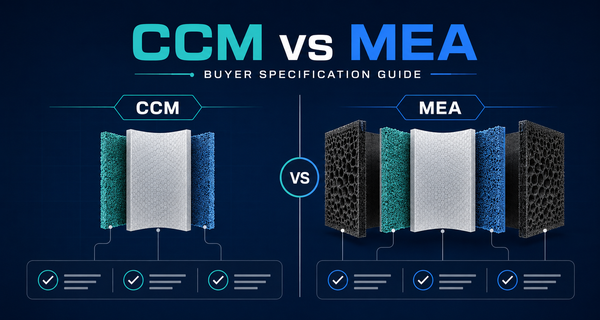
The practical difference between a CCM and an MEA is the scope of the supplied component. A catalyst-coated membrane (CCM) is normally a proton exchange membrane with an anode catalyst layer on one face and a cathode catalyst layer on the other. A membrane electrode assembly (MEA) is a broader term: in technical use it includes the membrane, catalyst layers, and gas diffusion layers, but commercial quotations may use "MEA" for a 3-layer CCM, a 5-layer assembly, or a framed configuration. Therefore, a buyer should never order by acronym alone. The drawing and purchase specification must list every included layer, material, dimension, and acceptance requirement.
CCM vs MEA at a Glance
Question | CCM | MEA | Buyer action |
What is included? | PEM with catalyst layers on both faces | Usually CCM plus anode and cathode GDLs; frame may be added | List every supplied component. |
Common layer count | Often called a 3-layer MEA | Often called a 5-layer MEA | Do not rely on the layer count alone. |
GDL selection | Chosen and assembled separately | Specified with the assembly | Name each GDL grade, side, and MPL orientation. |
Sealing | Unframed or framed CCM | Unframed, framed, or supplied with separate gaskets | Define the frame and gasket scope separately. |
Typical reason to buy | Maximum control over GDL and cell integration | Fewer loose functional layers during assembly | Choose according to the validated cell process. |
Why the Terminology Causes Purchasing Errors
There is no single commercial convention used by every laboratory, stack developer, and supplier. The U.S. Department of Energy describes a PEM fuel cell MEA as the membrane, two catalyst layers, and diffusion media together. In purchasing practice, however, "3-layer MEA" is commonly used for the catalyst-coated membrane without GDLs, while "5-layer MEA" normally adds two GDLs. A bonded seal frame may be described separately or included in a supplier's MEA name. These differences are not necessarily technical errors; they are scope differences that must be resolved before quotation and production.
For a focused layer-count explanation, read 3-Layer MEA vs 5-Layer MEA: What Is the Difference?.
What Is a Catalyst-Coated Membrane?
A CCM places the anode and cathode catalyst layers directly on opposite faces of the proton exchange membrane. Each catalyst layer is more than dry catalyst powder: it normally contains an electrocatalyst and ionomer arranged to provide reaction sites and ion-conducting pathways. For hydrogen-air PEM fuel cells, the anode and cathode formulations and loadings should be specified separately. The buyer should also define the coated area, uncoated border, side identification, and whether a bonded support or seal frame is included.
A CCM is often the better purchasing scope when the customer has already qualified its own GDL, gasket, compression, and assembly process, or when several diffusion-media options will be screened against one catalyst-coated core. It also gives direct access to the CCM for incoming inspection and material-development work. Thin membranes still require controlled handling, packaging, and alignment during downstream integration.
What Is a Membrane Electrode Assembly?
In the broad technical sense, an MEA combines the membrane, anode and cathode catalyst layers, and gas diffusion media. In a typical five-layer construction, one GDL sits outside each catalyst layer. The GDLs distribute reactants, conduct electrons and heat, help manage product water, and provide mechanical support at the interfaces with the bipolar plates. A microporous layer (MPL), when present, faces the catalyst layer unless the qualified design states otherwise.
A complete MEA may be easier to handle and repeat in cell assembly, but the word "complete" is meaningful only when the quotation defines whether GDLs are laminated, bonded, pre-aligned, or supplied as a matched loose set. It must also state whether the seal frame is bonded to the CCM, whether separate compressible gaskets are included, and which components establish the compressed thickness of the cell.
H2Gatech's gas diffusion electrode and diffusion-media page provides related information on GDL, MPL, and electrode configurations.
CCM or MEA: How Should a Buyer Choose?
Choose the supply scope that matches the component responsibility in your project. Buying a CCM is not a lower-performance choice, and buying a 5-layer MEA does not guarantee better cell performance. The result depends on the compatibility of the membrane, catalyst layers, GDLs, interfaces, sealing, compression, flow field, and operating conditions.
· Choose a CCM when your team will select, qualify, or change the GDLs independently.
· Choose a CCM when an existing stack process already controls GDL alignment, gasket thickness, and compression.
· Choose a 5-layer MEA when the GDL combination is already qualified and should be supplied with the coated membrane.
· Choose a framed assembly when edge handling, alignment, and bonded layer geometry are part of the supplier's agreed scope.
· Use a drawing and bill of materials whenever supplier terminology could affect price, inspection, or assembly responsibility.
Buyer Specification Checklist
Specification field | What to state | Why it matters |
Supply scope | CCM, 3-layer MEA, 5-layer MEA, framed assembly, or separate gasket set | Prevents missing or duplicated components. |
Dimensions | Active area, coating position, outer size, holes, radii, datum, and tolerances | Controls fit, sealing, alignment, and area calculations. |
Membrane | Manufacturer/grade, thickness, reinforcement, and allowed substitution | Affects resistance, crossover, handling, and durability. |
Catalyst layers | Anode/cathode chemistry, precious-metal loading basis, ionomer, and coating area | Defines the electrochemical core and cost basis. |
GDL/MPL | Grade per side, thickness, treatment, MPL presence and orientation, compressed target | Affects transport, contact, water management, and stack geometry. |
Frame/gasket | Material, adhesive, thickness per side, bonded area, hole pattern, and supplied form | Separates frame support from the gas-sealing function. |
Operating window | Temperature, humidity, pressure, differential pressure, gases, current range, and duty cycle | Allows materials to be matched to real service. |
Acceptance | Inspection method, tolerances, test protocol, documentation, traceability, and packaging | Creates a shared basis for sample approval and production. |
Define the Catalyst-Loading Basis
Catalyst loading must name both the side and the measurement basis. For example, 0.30 mgPt/cm² means 0.30 milligrams of platinum metal per square centimeter; it is not the same as 0.30 mg/cm² of total Pt/C catalyst powder. State anode and cathode values separately, identify the catalyst composition, define the active coated area, and agree on the loading tolerance and verification method. If the design uses platinum black, an alloy, or a non-platinum catalyst, use a unit that unambiguously identifies the relevant metal or catalyst mass.
Do Not Treat the Frame and Gasket as the Same Item
A polymer frame bonded around a CCM can improve handling, locate the active window, and help build the intended edge thickness. A gasket is the sealing component used with the cell hardware to prevent reactant leakage. Some designs combine functions, but buyers should not assume that a framed CCM includes the compressible gaskets required between the MEA and bipolar plates. Define the material, adhesive, thickness, cut geometry, chemical compatibility, and target compressed stack-up for each item.
Agree on Inspection and Testing Before Samples Are Made
Incoming requirements should match the delivered scope. For a CCM, useful checks may include appearance, pinholes or coating defects, external dimensions, catalyst-area position, thickness, and catalyst loading by an agreed method such as XRF where applicable. A framed or five-layer MEA may also require GDL grade verification, orientation, assembly thickness, bond integrity, or leak-related checks. Electrochemical acceptance requires a defined test fixture, compression, break-in procedure, gas composition, flow, temperature, humidity, pressure, and polarization protocol. Results from different fixtures are not automatically comparable.
Practical rule: The supplier's certificate should report only agreed, measurable characteristics. Cell performance belongs in the acceptance plan only when both parties use the same test protocol and hardware assumptions.
Write the RFQ So the Scope Cannot Be Misread
A request such as "100 cm² fuel cell MEA, 0.3 mg/cm²" is incomplete. It does not define the included layers, outer geometry, catalyst-loading basis, GDL, frame, gasket, operating conditions, or test method. A stronger request follows a consistent sequence:
· Application and PEM fuel cell operating window
· Supply scope and cross-section drawing
· Active area, external dimensions, holes, orientation, and tolerances
· Membrane, anode catalyst layer, and cathode catalyst layer
· GDL/MPL specification for each side, if included
· Frame, gasket, bonding, and compressed-thickness requirements
· Inspection, test protocol, documents, packaging, quantity, and forecast
For the complete RFQ workflow, use How to Specify a Custom Fuel Cell MEA: A Practical Buyer's Guide.
Frequently Asked Questions
Is a CCM the same as a 3-layer MEA?
Often, yes. In common purchasing language, both terms describe a membrane with catalyst layers on the anode and cathode faces. Because terminology varies, confirm whether any frame, backing, or other layer is included.
Does an MEA always include gas diffusion layers?
In the broad technical definition, the diffusion media are part of the PEM fuel cell MEA. Commercially, some suppliers also call a CCM a 3-layer MEA. The quotation and drawing should explicitly say whether the anode and cathode GDLs are included.
Is a 5-layer MEA better than a CCM?
Not automatically. A five-layer format integrates the GDLs, while a CCM leaves GDL selection and assembly to the customer. Performance depends on the complete material combination, interfaces, compression, cell hardware, and operating conditions.
Can the anode and cathode use different GDLs?
Yes. The two sides have different reactant and water-management roles. When different grades are used, identify each part number, MPL side, orientation, thickness, and treatment on the drawing and bill of materials.
Request a CCM or MEA Specification Review
H2Gatech supports customized catalyst-coated membranes, 3-layer and 5-layer PEM fuel cell MEAs, framed configurations, and related diffusion materials. Send your drawing, intended supply scope, operating conditions, catalyst-loading basis, GDL and sealing requirements, sample quantity, and acceptance plan. Explore H2Gatech membrane electrode assembly solutions or contact H2Gatech for a specification review.
Technical References
U.S. Department of Energy - Parts of a Fuel Cell
Freudenberg Performance Materials - Gas Diffusion Layers
U.S. DOE Hydrogen Program - In-Line Quality Control of Polymer Electrolyte Membrane Fuel Cell Components
Related H2Gatech Resources
H2Gatech - Membrane Electrode Assembly
H2Gatech - Gas Diffusion Electrode