
Fuel Cell MEA Manufacturer Buyer Checklist
What Buyers Should Check When Choosing a Fuel Cell MEA Manufacturer
Choosing a fuel cell MEA manufacturer is not only a price comparison. The supplier must be able to understand the cell design, define the supplied layer structure, control expensive functional materials, reproduce an approved sample, inspect the finished assembly, and explain which records support each shipment. A strong supplier evaluation therefore examines evidence, not slogans.
This buyer checklist focuses on custom catalyst-coated membranes and membrane electrode assemblies for PEM fuel cells. The same questions can also guide related electrochemical projects, but materials, transport layers, sealing, test methods, and acceptance criteria must be adapted to the actual application.
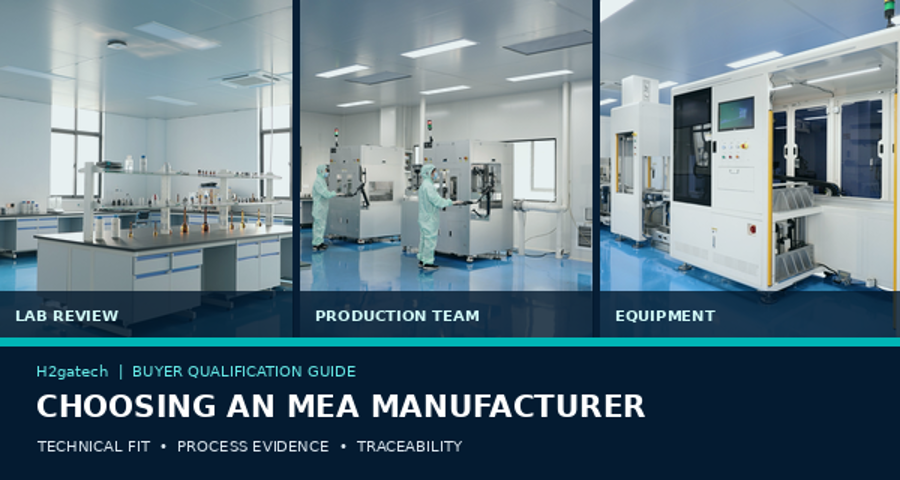
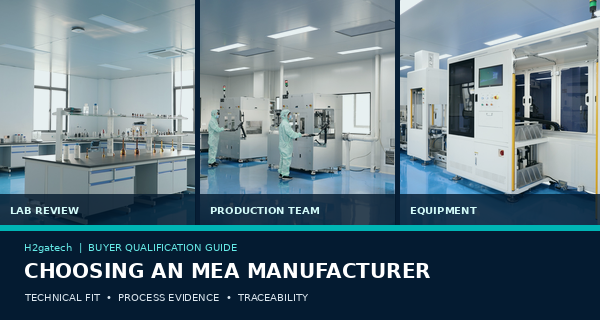
A supplier review should connect technical development, controlled production, inspection evidence, and batch traceability.
Begin With Technical Fit, Not Factory Size
A large facility does not automatically mean that a manufacturer understands your MEA. The first test is whether the supplier asks the right questions: fuel-cell type, active area, cell hardware, membrane, anode and cathode catalyst layers, catalyst-loading basis, gas-diffusion layers, frame or gasket interface, operating window, validation method, and forecast quantity. Missing inputs should be identified before materials are committed.
H2gatech engineering observation: an RFQ that says only “100 cm² MEA, 0.3 mg/cm²” is not ready for controlled production. It does not state whether the value is mgPt/cm² or total catalyst powder, whether 100 cm² means catalyst area or another outline, which layers are included, or how the assembly will be compressed and sealed.
Use the detailed input list in How to Specify a Custom Fuel Cell MEA before requesting samples.
Ten Checks for Evaluating an MEA Manufacturer
Audit area | Evidence to request | Warning sign |
1. Application review | Questions that connect the MEA to cell hardware, duty cycle and operating conditions | A quotation based only on outside dimensions |
2. Supply definition | Drawing and layer list for CCM, 3-layer, 5-layer, framed or sealed scope | “Complete MEA” without naming included layers |
3. Material control | Membrane, catalyst, ionomer, GDL, frame and adhesive identities or agreed property ranges | Unannounced substitutions or vague “equivalent material” |
4. Loading basis | Separate anode/cathode values, unit basis, coated area and verification method | mg/cm² without stating metal or powder basis |
5. Sample control | Sample ID, drawing revision, material traceability and test conditions | An untraceable sample approved only by appearance |
6. Process evidence | Explanation of controlled inputs, setup confirmation, equipment oversight and in-process checks | Automation claims without defined controls |
7. Inspection plan | Agreed characteristics, methods, sampling, limits and response to abnormal results | A generic “100% inspection” statement |
8. Test comparability | Defined fixture, compression, break-in, gases, flows, temperature, humidity and pressure | Performance data without test conditions |
9. Change control | Rules for material, drawing, process or supplier changes and revalidation | Changes made because the substitute “looks similar” |
10. Release records | Lot identity, inspection evidence, packaging, certificates and deviation status | Shipment documents disconnected from the approved revision |
Verify What the Supplier Will Actually Deliver
Commercial terminology is not fully standardized. One quotation may use “MEA” for a catalyst-coated membrane, while another includes two GDLs and a bonded frame. Ask for a cross-section or layer list and confirm the catalyst-coated area, outer dimensions, holes, orientation marks, GDL outlines, frame overlap, gasket responsibility, and packaging method.
The acceptance plan should match the supply scope. A CCM may be checked for appearance, coating-area position, dimensions, membrane damage, and catalyst loading by an agreed method. A framed 5-layer assembly may also require GDL grade and orientation checks, assembled thickness, alignment, bond condition, or project-specific leak-related verification. Not every method applies to every construction.
See H2gatech’s available customization scope on the Membrane Electrode Assembly product page.
Ask How Materials and Changes Are Controlled
MEA performance depends on interacting materials. A membrane replacement can affect resistance, crossover, dimensional behavior, handling and sealing. A catalyst or ionomer change can alter ink behavior and the structure of the coated layer. A different GDL can change thickness, compression, contact and water transport. The buyer should therefore distinguish approved alternatives from changes that require notification, new samples or requalification.
National-laboratory manufacturing research treats material properties, ink formulation, coating, drying, layer structure, metrology and electrochemical performance as connected variables. That does not prescribe one universal production route, but it supports a practical audit principle: the manufacturer should understand which inputs are critical for the approved configuration and how a proposed change will be evaluated.
Look for Process Evidence, Not an Automation Label
Enclosed or automated equipment can improve the repeatability of defined motion, timing, positioning, pressure or recipe execution where those functions are built into the station. It does not by itself prove that the correct drawing, material, parameter window, tooling, inspection method or operator response was used. Ask how setup is confirmed, which information is recorded, and what happens when a result is outside the agreed condition.

H2gatech personnel work at multiple enclosed equipment stations. The photograph supports controlled production and operator oversight but does not establish a specific cleanroom class.
For a closer look at the photographed facility, read Inside H2gatech’s MEA Manufacturing Facility.
Connect Sample Approval to Repeat Production
A successful prototype is useful only when the supplier can identify what was built and what the customer approved. The sample record should connect the piece to a drawing revision, layer construction, material identities, loading definition, relevant production record, inspection results and test conditions. The repeat-batch specification should then freeze the approved product definition or clearly state which variations remain open.
Ask what will happen if a specified membrane, GDL, catalyst, frame film or adhesive is unavailable. A professional answer should separate commercially convenient substitution from technically justified equivalence. Where a change can affect form, fit, interfaces or performance, the buyer and manufacturer should agree whether review, sample approval or full requalification is required.
Review Inspection, Measurement and Test Claims Carefully
DOE-supported quality-control work has examined defect detection in membranes, CCMs, GDEs and GDLs because defects and variation can consume expensive materials and may affect cell reliability. The lesson for supplier qualification is not that every manufacturer must own the same inspection technology. It is that the inspection method, detectable condition, sampling approach and acceptance rule should be appropriate to the product and understood by both parties.
Avoid accepting a general statement such as “all parts are tested” without asking what the test measures. Visual inspection, dimensions, mass, thickness, electrical resistance, catalyst-loading verification, leak testing and single-cell performance answer different questions. A certificate should report only agreed characteristics measured by a defined method.
For H2gatech’s buyer-facing shipment checks, see Fuel Cell MEA Quality Inspection Before Shipment.
Require Comparable Electrochemical Data
A polarization curve is not a universal product label. Results depend on the cell fixture, flow field, active-area definition, compression, break-in procedure, gas composition, stoichiometry or flow, temperature, humidity, pressure, control mode and data-acquisition method. Differences between two laboratories may reflect the test system as well as the MEA.
For sample approval, define the protocol before comparing suppliers. If the buyer will test in its own hardware, record the MEA identity and the exact test conditions. If the supplier performs the test, ask whether the setup represents the intended application and how repeatability or reference performance is monitored.
Check Traceability, Documentation and Packaging
Traceability should be proportionate to the project. At minimum, the buyer should know how the shipped part number and lot relate to the current drawing, approved construction and required inspection record. More demanding programs may also specify material-lot references, retained samples, certificate fields, nonconformance history, record retention and change-notification periods.
Packaging is part of product protection. Thin membranes and catalyst layers can be damaged by particles, bending, abrasion, moisture exposure, pressure or direct contact with unsuitable separators. Agree on orientation, protective liners, quantity per pack, labeling, storage conditions and handling warnings that fit the actual MEA construction.
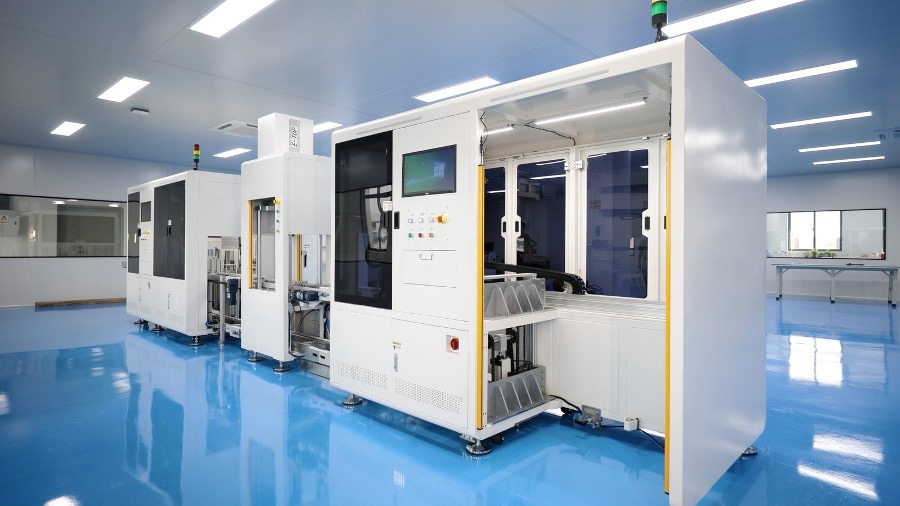
Enclosed equipment can support repeatable execution after the product definition, approved settings, material identity and inspection plan are established.
Supplier Qualification Evidence Checklist
Evidence group | What to define or request |
Technical input | Application summary, dimensioned drawing, layer list, active area, orientation, materials, loading basis and operating window |
Quotation scope | Included layers and processing, sample quantity, documentation, tooling, testing, packaging, lead time and commercial assumptions |
Sample record | Sample ID, drawing revision, material definition, construction, inspection results and customer evaluation status |
Production definition | Released drawing and BOM, approved alternatives, critical controls, inspection plan and packaging instruction |
Test evidence | Fixture, active area, compression, break-in, gases, flows, temperature, humidity, pressure and data method |
Release package | Part number, lot identity, quantity, agreed inspection results, certificate fields and deviation status |
Change control | Notification, review, reapproval and requalification rules for material or process changes |
Common Red Flags During Supplier Evaluation
· The quotation uses “MEA” without listing which layers, frame or gasket are included.
· Catalyst loading is quoted in mg/cm² without identifying the metal, oxide or powder basis.
· A material is described as equivalent without a comparison or validation plan.
· Performance data is presented without cell hardware and operating conditions.
· The supplier promises a tolerance, capacity or inspection accuracy before reviewing the drawing.
· The approved sample cannot be linked to a controlled revision or build record.
· Automation is presented as a substitute for setup control, inspection and trained review.
· Packaging and change-notification requirements are postponed until after the order.
Frequently Asked Questions
What is the most important document when selecting an MEA manufacturer?
There is no single document that proves capability. The strongest evidence is a connected set: technical input, quotation scope, controlled drawing and BOM, traceable sample record, validation protocol, inspection plan, change rules and release documentation.
Should a buyer require an ISO cleanroom class?
Only when a verified environmental classification is genuinely required by the product or qualification plan. Otherwise, ask which cleanliness, handling, temperature, humidity, material-flow and contamination controls apply to the specific MEA.
Does automated equipment guarantee consistent MEAs?
No. Equipment can improve repeatability of defined actions, but output still depends on input materials, current documents, setup, approved settings, operator oversight, maintenance, inspection and response to abnormal results.
How should catalyst loading be specified?
State the anode and cathode separately, identify the basis such as mgPt/cm² or mg catalyst powder/cm², define the coated area, and agree on the calculation or measurement method.
Can two suppliers’ polarization curves be compared directly?
Only when the fixture, active area, compression, break-in, reactants, flows, temperature, humidity, pressure and measurement method are sufficiently comparable. Otherwise, differences may come from the test setup.
What should be approved before a repeat batch?
Approve the drawing revision, layer structure, materials, loading basis, critical dimensions, orientation, inspection plan, test or sample acceptance basis, permitted alternatives, packaging, traceability and change-control requirements.
Discuss Your MEA Supplier Qualification Requirements
H2gatech supports custom CCM and MEA projects from specification review and sample preparation through controlled production and shipment inspection. Send your drawing, layer structure, material preferences, catalyst-loading basis, cell conditions, validation plan, target quantity and required documents so the engineering team can review the qualification path. Contact H2gatech to discuss the evidence and sample plan needed for your project.
Technical References
• U.S. DOE - In-Line Quality Control of Polymer Electrolyte Membrane Materials - research on detecting defects and variation in membranes, CCMs, GDEs and GDLs for production-line quality control.
• NREL and Partner Laboratories - Roll-to-Roll Advanced Materials Manufacturing Lab Collaboration - scale-up work connecting multilayer processing, metrology, characterization and MEA manufacturing challenges.
• NREL - Material-Process-Performance Relationships in PEM Catalyst Inks and Coated Layers - research linking ink properties, coating and drying conditions, electrode structure, variability and electrochemical