
Rebuildable PEM Fuel Cell Stack for R&D
Why Use a Rebuildable PEM Fuel Cell Stack for Research and Development
A rebuildable PEM fuel cell stack gives researchers and product developers controlled access to the layers that determine electrochemical and mechanical behavior. Instead of treating the stack as a sealed power product, the user can open a purpose-designed fixture, inspect selected components, replace an MEA, GDL, seal, or plate when the design allows it, rebuild the same hardware, and run the next defined experiment.
That access is valuable only when the experiment remains controlled. Reassembly can change layer orientation, sealing, contact pressure, reactant distribution, contamination risk, and conditioning history. A useful research stack therefore combines serviceable hardware with a documented build sequence, defined replacement parts, safe operating limits, and a repeatable test protocol.
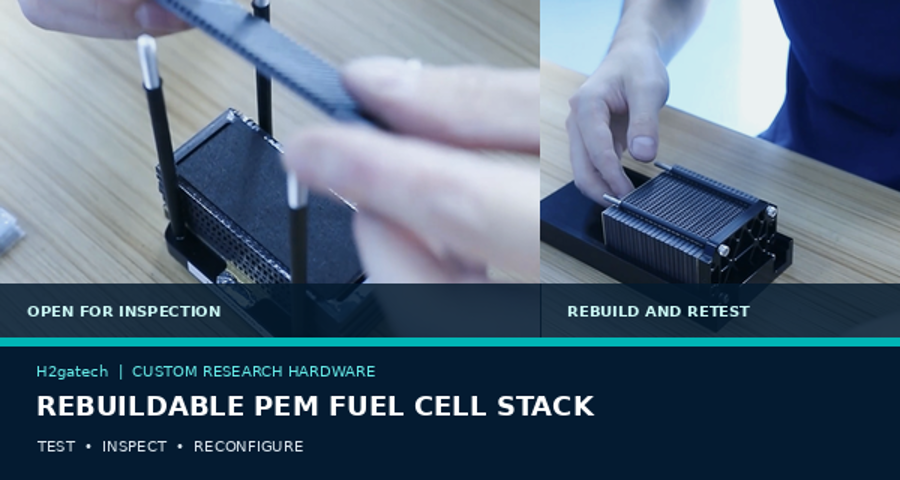
A custom rebuildable stack can provide direct access for inspection and component trials while retaining a defined test fixture.
What Is a Rebuildable PEM Fuel Cell Stack?
In this article, “rebuildable” means that the stack or test fixture is intentionally designed to be opened and reassembled through a defined procedure. The term does not mean that components should be changed while the stack is operating. Hydrogen and electrical power must be isolated, pressure relieved, and the system made safe before any mechanical work.
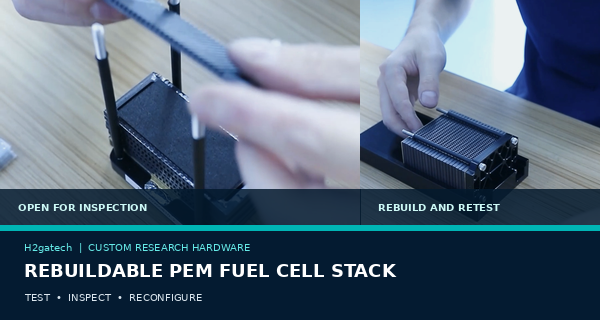
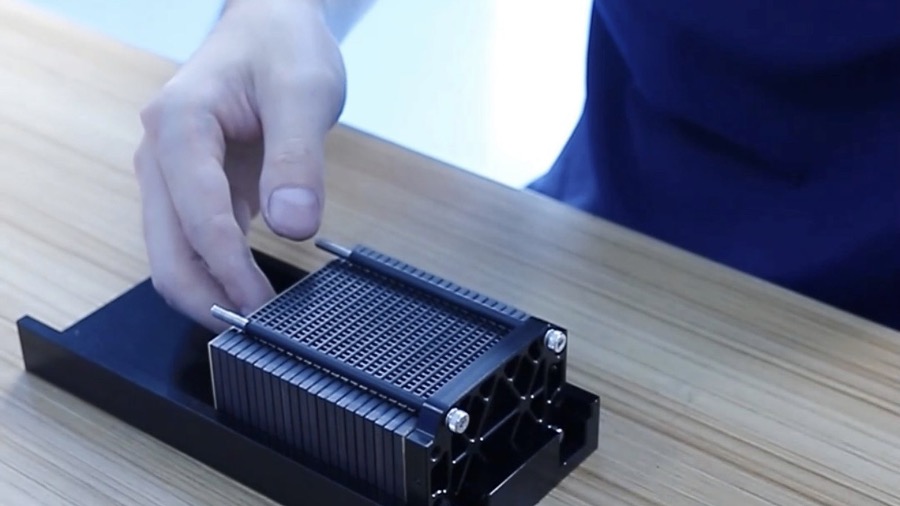
The photographed H2gatech unit shows a compact layered assembly located by guide rods, with a top component that can be lifted to expose the stack. The photographs support a serviceable, manually accessible construction. They do not establish the cell count, active area, flow-field design, cooling method, pressure rating, electrical output, or materials, so those items must be defined separately for each custom project.
Rebuildable Research Stack vs Integrated Production Stack
Comparison area | Rebuildable R&D stack | Integrated production stack |
Primary objective | Controlled access for experiments, inspection, component comparison, and development | Compact integration, repeat operation, environmental robustness, and application delivery |
Component access | Designed to be opened using a documented sequence | May not be intended for frequent field disassembly |
Variables | Selected MEA, GDL, seal, plate, compression, or cell configuration may be changed by plan | Product configuration is normally released and tightly controlled |
Typical evidence | Build record, component IDs, leak check, conditioning record, test conditions, and comparison data | Production release, system validation, service plan, and application-specific compliance |
Main risk | A rebuild changes more variables than the researcher intended | A design or production change affects released performance or reliability |
Neither architecture is universally better. A rebuildable test stack is useful when learning and access are priorities. A production stack may prioritize packaging, mass, automated assembly, long service intervals, and system integration. The purchase specification should state which objective matters.
Where a Rebuildable Stack Adds Engineering Value
Use case | What the hardware enables | What must be recorded |
MEA screening | Compare approved MEA candidates in the same hardware | MEA ID, active area, orientation, conditioning, compression, gases, temperature, humidity, pressure, flow or stoichiometry, and current program |
GDL/MPL study | Assess substrate, thickness, hydrophobic treatment, MPL presence, and side orientation | GDL grade, cut outline, MPL direction, compressed thickness, assembly position, and water-management observations |
Seal evaluation | Check frame or gasket material, thickness, overlap, and compatibility with the hardware | Seal ID, new or reused status, torque/compression method, leak-test method, and post-test condition |
Plate or flow-field trial | Evaluate a defined hardware change without replacing the complete test platform | Plate revision, channel design, surface condition, manifold connection, contact interfaces, and operating window |
Failure investigation | Open the tested unit to examine visible locations of damage, contamination, flooding, drying, or misalignment | Pre-test record, operating history, shutdown condition, disassembly order, photographs, and sample-preservation plan |
Training and method development | Teach a controlled build, safety sequence, leak check, conditioning, and data review | Approved procedure, supervision, limits, acceptance criteria, and deviation record |
1. Compare MEAs Without Losing the Test Context
Material screening is a common reason to use serviceable hardware. A developer may compare membrane grade, catalyst-layer construction, catalyst loading, ionomer approach, or complete MEA architecture. The hardware can remain constant, but the result is only meaningful when all other influential conditions are also controlled.
The European Commission Joint Research Centre notes that single-cell experiments are widely used for material research and screening before short-stack or commercial-scale testing. It also warns that different test hardware and flow fields can affect results. The practical lesson is simple: define the fixture as part of the test method, not as an invisible container.
For the product inputs needed before an MEA trial, use How to Specify a Custom Fuel Cell MEA.
2. Inspect and Replace Selected Stack Components
Opening the stack can provide access to the MEA, gas diffusion media, seals, plates, current-collection interfaces, and other project-specific layers. That access helps an engineering team distinguish an electrochemical issue from a mechanical interface problem. It also makes it possible to preserve, photograph, or analyze a suspect component after a test.
Replaceable does not mean interchangeable without review. A new GDL can change thickness and compressive behavior. A different gasket can change sealing and the mechanical load carried by the active layers. A membrane or framed MEA can change the thickness stack. The build drawing and compression approach must be checked whenever a component changes.
Review customizable MEA structures on the H2gatech Membrane Electrode Assembly page.
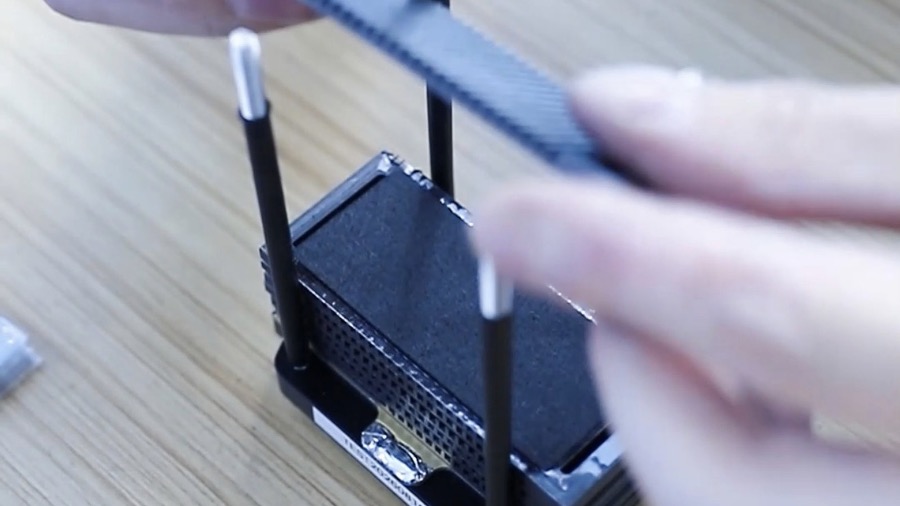
The top component is removed to provide access to the layered assembly. Actual internal parts and specifications depend on the custom design.
3. Use Post-Test Inspection to Improve the Next Experiment
Performance data can identify when voltage, resistance, mass transport, or stability changes, but it does not always reveal the physical cause. A controlled teardown can add evidence: visible seal movement, imprint patterns, contamination, liquid-water locations, local discoloration, surface damage, or an orientation error. These observations are diagnostic clues, not conclusions by themselves.
Plan the teardown before the test ends. Record the shutdown condition, allow the hardware to reach a safe state, preserve orientation, photograph each stage, label removed parts, and avoid cleaning surfaces before the inspection record is complete. If laboratory analysis is planned, define how samples will be handled and stored.
Repeatability Depends on More Than the Stack Hardware
Harmonized PEM fuel cell protocols specify variables such as temperature, pressure, humidification, gas flow, gas composition, and load procedure because changes in these conditions can alter performance and durability. Stack-level guidance also emphasizes that the developer should provide pressure, voltage, current, temperature, dew point, utilization, and differential-pressure limits together with a written test plan.
For a rebuildable stack, the assembly state becomes another test variable. The team should define the tightening or compression method, component condition, seal-reuse rule, alignment checks, leak-test method, conditioning sequence, and stabilization criterion. If these are not recorded, a performance difference may come from the rebuild rather than the material under study.
A Practical Rebuild-and-Test Workflow
Stage | Required action |
1. Define the question | Choose one primary variable and state the expected comparison. |
2. Freeze the baseline | Identify the hardware revision, component list, operating window, and reference build. |
3. Prepare safely | Isolate hydrogen and electrical energy, relieve pressure, allow safe cooling, and follow the approved procedure. |
4. Open and document | Preserve orientation, photograph each stage, label parts, and record visible conditions. |
5. Replace or reconfigure | Install only identified components that fit the approved thickness, seal, and interface design. |
6. Reassemble consistently | Use the specified alignment, tightening/compression sequence, and cleanliness controls. |
7. Verify before operation | Complete visual, electrical, connection, and leak-related checks required by the project. |
8. Condition and test | Use the same break-in, gases, flows, temperature, humidity, pressure, and data procedure. |
9. Review the evidence | Compare performance, build records, inspection findings, and any deviations before the next change. |
Reassembly Risks That Should Be Managed
·A layer is rotated, flipped, offset, or installed in the wrong anode/cathode position.
·A used gasket does not recover to its original thickness or sealing behavior.
·Particles, fingerprints, fibers, or residual liquid contaminate an interface.
·A changed GDL, MEA, or seal alters the total compressed thickness.
·Fastener tightening or fixture compression is not reproduced from the reference build.
·Ports or manifolds are reconnected incorrectly, or a leak check is skipped.
·The new test starts before the same conditioning and stabilization criteria are met.
What to Specify When Ordering a Custom Rebuildable Stack
RFQ section | Information to provide or agree |
Research objective | MEA screening, GDL study, sealing study, flow-field work, durability, diagnostics, training, or another defined purpose |
Electrochemical scope | Fuel and oxidant, target operating range, expected current/voltage measurement, and intended test protocol |
Cell configuration | Required cell count, active area, electrical connection, and whether configuration changes are needed |
Component interfaces | MEA format, GDL, plate, frame/gasket, current collector, end plate, and allowable material alternatives |
Mechanical method | Alignment features, compression or tightening method, thickness stack, access frequency, and replacement-part strategy |
Fluid connections | Port type and layout, reactant routing, purge/drain needs, pressure limits, and cooling concept if required |
Instrumentation | Cell-voltage monitoring, temperature locations, pressure measurement, flow control, and data connections |
Safety and verification | Operating limits, shutdown procedure, leak-test approach, electrical checks, and user documentation |
Deliverables | Drawing, BOM or approved layer list, assembly/rebuild procedure, spare seals or components, test record, and packaging |
H2gatech engineering note: describe the experiment before specifying the hardware. A request for a “removable stack” does not reveal which layer must be accessible, how often it will be opened, which variables must remain fixed, or what test equipment will connect to it. Those answers determine whether the fixture is genuinely useful for the intended work.
A compact custom stack after assembly. The photograph shows the mechanical form only; rating and operating specifications are project-specific.
How This Article Differs From Our Stack Assembly Guide
H2gatech’s existing stack assembly article explains bipolar-plate direction, component orientation, repeated-cell alignment, and controlled compression during the build. This article answers a different buyer question: why a serviceable stack is useful as a research platform, what experiments it can support, and what information must be controlled each time it is opened and rebuilt.
For the detailed assembly perspective, read PEM Fuel Cell Stack Assembly: Bipolar Plate Alignment.
For available stack solutions, visit H2gatech Hydrogen Fuel Cell Stacks.
Frequently Asked Questions
Is a rebuildable PEM stack the same as a production power stack?
Not necessarily. A rebuildable stack is selected when component access, controlled experiments, or inspection is important. A production stack may prioritize packaging, mass, environmental durability, automated assembly, and long-term operation. Some custom designs combine elements of both, but the intended use should be stated.
Can the MEA be replaced after every test?
It can be replaced if the fixture and procedure are designed for that purpose. The team must also define rules for GDLs and seals, because their condition and compressed thickness can influence the next result.
Can cell count be changed?
Only when the mechanical, electrical, fluid, compression, control, and safety design explicitly supports the new configuration. Do not assume that a stack is reconfigurable merely because it can be opened.
Will the same MEA give the same result after reassembly?
Not automatically. Differences in alignment, compression, seal condition, contamination, conditioning, or operating conditions can change the result. A controlled rebuild and matched test protocol are essential.
What information should be included in an RFQ?
Provide the research objective, cell count, active area, MEA/GDL/seal scope, operating window, reactant and cooling connections, compression method, instrumentation, safety limits, test method, documentation, and required spare parts.
Is a visible inspection enough after rebuilding?
No. Visual inspection is useful, but the project may also require connection checks, electrical checks, and an appropriate leak-test or pressure-verification procedure before hydrogen operation. Requirements must match the actual design and operating limits.
Discuss a Custom Research Stack With H2gatech
A rebuildable PEM fuel cell stack should be designed around the experiment, not selected from appearance alone. Send H2gatech your target test, cell configuration, active area, component scope, gas and cooling connections, operating limits, instrumentation needs, and preferred validation method. The engineering team can review a custom fixture and replacement-part plan for your project. Contact H2gatech to begin the technical review.
Technical References
• European Commission Joint Research Centre — EU Harmonised Test Protocols for PEMFC MEA Testing - reference and stressor conditions for comparable single-cell MEA performance and durability testing.
• European Commission Joint Research Centre — Reference Hardware for Harmonised Single PEM Fuel Cell Testing - explains material screening before scale-up and the influence of test hardware and compression on comparison.
• Argonne National Laboratory and European Commission JRC — PEM Fuel Cell Stack Testing Protocol Overview - describes stack test planning, operating limits, performance characterization, durability testing, and data-quality considerations.