
Automotive Industry
Automotive Industry and Hydrogen Fuel Stack Technology
As the global automotive industry accelerates its transition toward carbon neutrality in 2026, hydrogen fuel stack technology has emerged as a critical pillar for zero-emission transportation. While battery electric vehicles (BEVs) dominate the passenger car market, hydrogen fuel cell electric vehicles (FCEVs) are carving out a vital role in heavy-duty logistics and long-range transport.
What is a Hydrogen Fuel Stack?
A hydrogen fuel stack is the "engine" of a fuel cell vehicle. It is not a single component, but a modular assembly of hundreds of individual fuel cells layered together. Since a single fuel cell produces a relatively small amount of electricity (less than 1 volt), multiple cells are "stacked" in a series to generate the high voltage and power required to propel a vehicle.
In the automotive context, most manufacturers use Proton Exchange Membrane (PEM) technology. These stacks are favored for their compact size, low operating temperatures, and ability to start quickly, making them ideal for the variable demands of driving.
Features of Hydrogen Fuel Stack
Hydrogen fuel stacks offer several distinct advantages that differentiate them from traditional internal combustion engines and large-scale battery systems:
Zero Tailpipe Emissions: The only byproduct of the chemical reaction within the stack is pure water vapor and heat.
High Energy Density: Hydrogen stores more energy by weight than lithium-ion batteries, allowing for lighter powertrains in heavy-duty applications.
Rapid Refueling: Unlike batteries that require hours to charge, a fuel stack system can be replenished with pressurized hydrogen in 3 to 5 minutes.
Performance Stability: Unlike batteries, which can lose significant range in freezing temperatures, fuel stacks maintain consistent efficiency and power output in diverse climates.
Modular Design: Stacks can be scaled up or down by adding or removing individual cells to meet the power requirements of anything from a compact sedan to a class-8 semi-truck.
Work Principle of Hydrogen Fuel Stack
The fuel stack operates through an electrochemical process rather than combustion. The process involves three main components: an anode (negative post), a cathode (positive post), and an electrolyte membrane.
Hydrogen Input: Hydrogen gas from the vehicle's tanks is channeled to the anode side of the stack.
The Reaction: A catalyst (usually platinum) at the anode splits the hydrogen molecules into protons and electrons.
Proton Migration: The specialized membrane allows only the protons to pass through to the cathode.
Electricity Generation: The electrons are forced to travel through an external circuit to reach the cathode. This flow of electrons creates the electrical current used to power the vehicle's motor.
Water Formation: At the cathode, the electrons and protons reunite and combine with oxygen taken from the ambient air, creating water (H2Ocap H sub 2 cap O𝐻2𝑂 ) as the final byproduct.
How is a Hydrogen Fuel Stack Used in an EV?
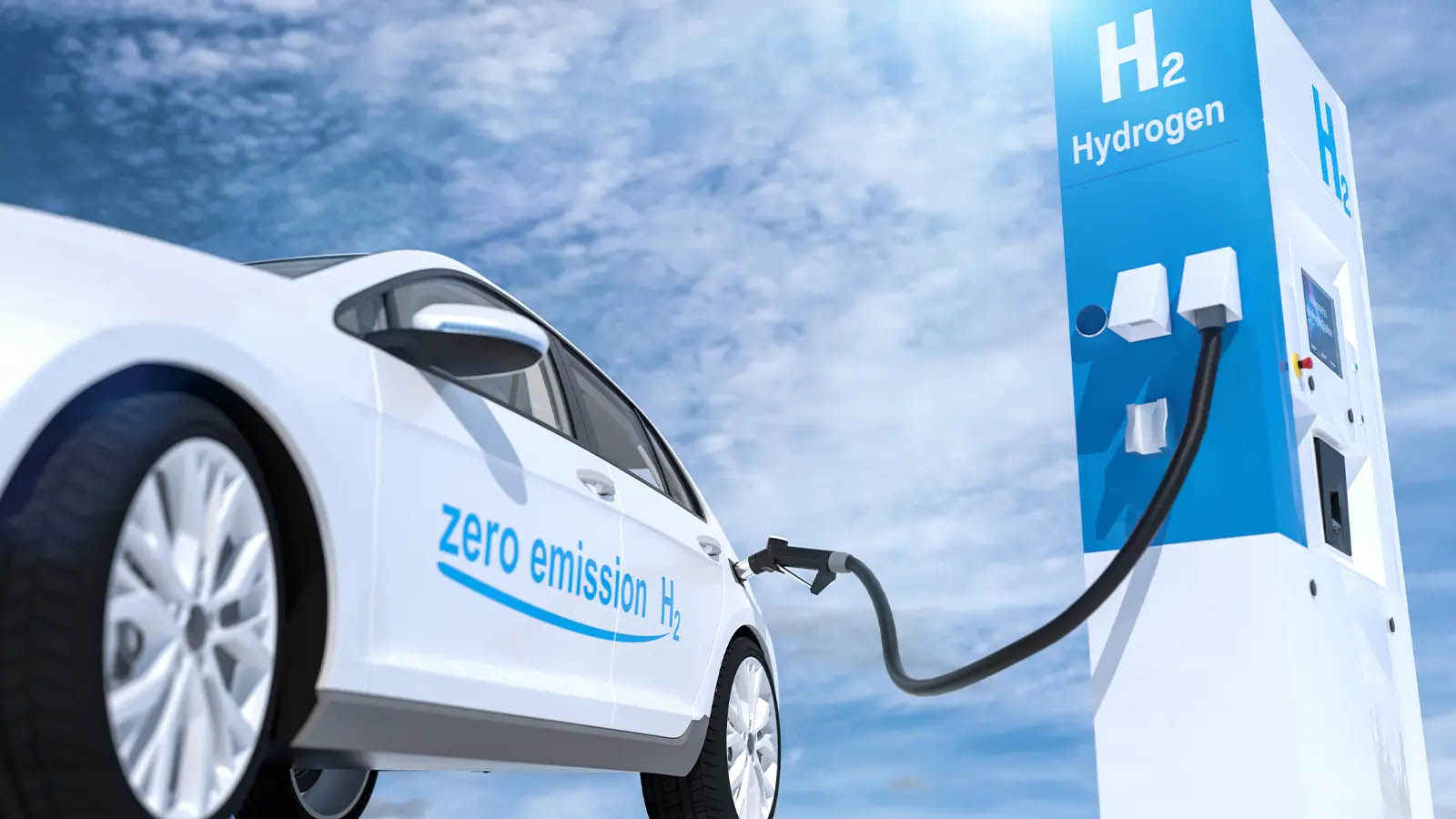
In a Hydrogen Fuel Cell Electric Vehicle (FCEV), the fuel stack replaces the large battery pack found in a standard EV as the primary energy source. However, the two technologies often work in tandem.
Energy Conversion: The stack generates DC electricity, which is sent through a power inverter to drive the electric traction motor.
Hybrid Buffer: Most FCEVs, such as the 2026 Toyota Mirai or the Hyundai Nexo, include a small "buffer" battery. This battery stores energy recovered during regenerative braking and provides extra power during quick acceleration.
Integration: The stack is typically located under the hood or chassis, connected to high-pressure hydrogen storage tanks. The silent, electric-drive experience is identical to a battery EV, but the "fuel" is stored as gas rather than chemical energy in a cell.
Manufacture of Hydrogen Fuel Stack
H2Gatch is a professional hydrogen fuel cell manufacturer dedicated to the Hydrogen Fuel Cell membrane electrode (MEA), hydrogen fuel cell stack system, and other related equipment. If you are looking for hydrogen fuel stacks in bulk, feel free to contact us.
Next:
Backup Power